
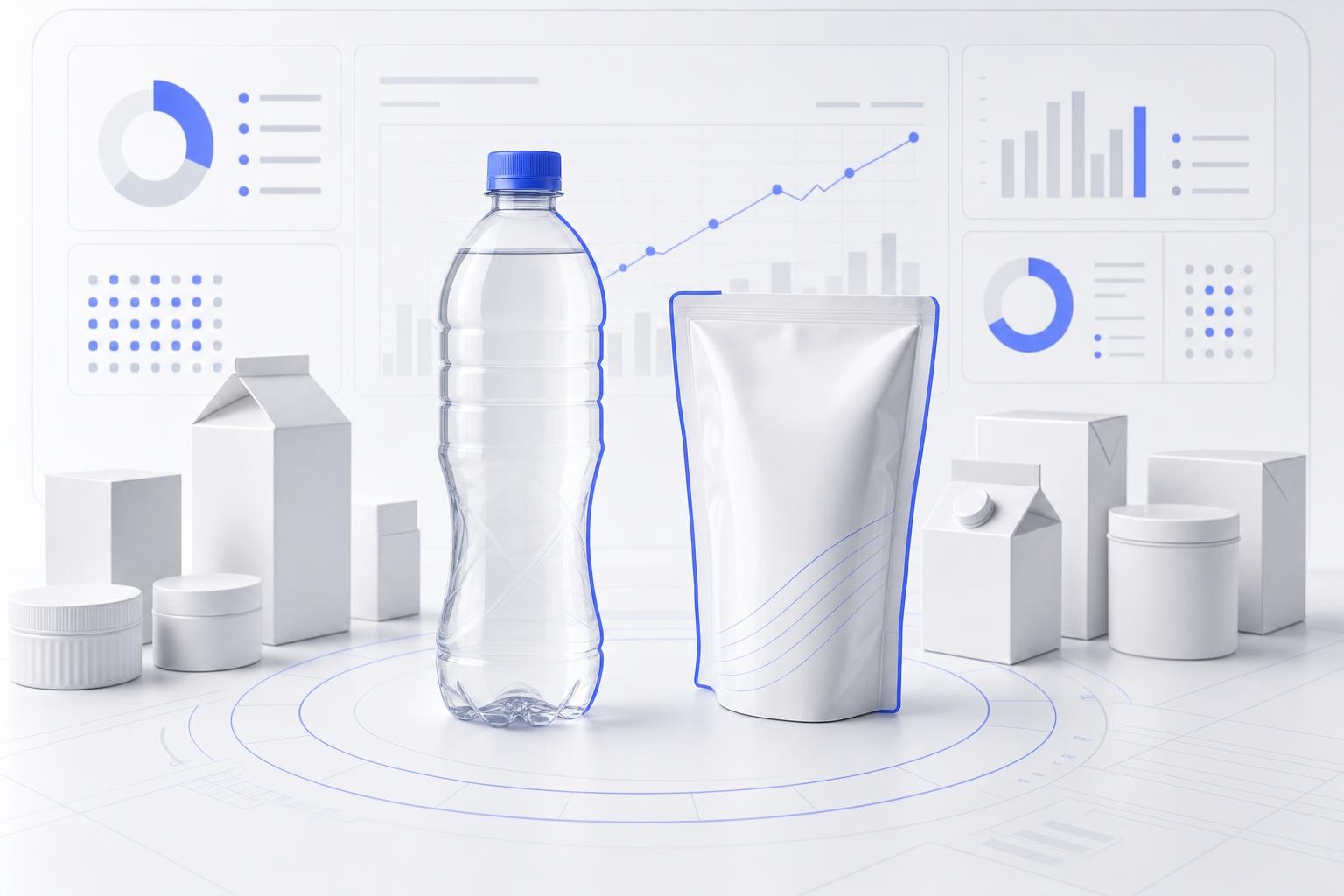
Picture two packages sitting side by side on a table: a PET bottle and a multilayer pouch with a barrier layer. Both weigh 25 grams. Both fall under the same EPR system. But from 2030 onward, they will exist in completely different regulatory and financial worlds - because the PPWR no longer treats recyclability as a yes/no question, but as a measurable performance grade.
This guide walks through the official assessment methodology step by step: how the performance grades are defined, which factors feed into the assessment, what the delegated acts will govern - and what each grade means in concrete terms for your EPR fees.
What the PPWR Means by "Recyclability"
The old Packaging Directive left a lot of room for interpretation. The PPWR (Regulation (EU) 2025/40) entered into force on February 11, 2025, and applies directly across all 27 EU Member States from August 12, 2026 - with no national transposition required. That means no national loopholes, no interpretive buffer.
Article 6 of the PPWR defines recyclability on two levels:
- Design for Recycling (DfR) - from 2030: Packaging must be designed so that it can be recycled using current best available techniques, and the resulting secondary materials must be capable of substituting primary raw materials.
- Recycled at Scale (RaS) - from 2035: Packaging must not only be theoretically recyclable, but must actually be collected, sorted, and recycled in significant volumes across EU infrastructure.
This is a fundamental departure from previous practice: a package can be well designed and still fail if the sorting or recycling infrastructure isn't there.
Performance Grades A through E: What Does the Regulation Actually Say?
The grading system is established in Annex II of Regulation (EU) 2025/40 and measures the share of a packaging unit - calculated by weight - that can be effectively recycled.
| Leistungsstufe | Recyclingfähigkeit (Gewicht) | Ab 2030 | Ab 2038 | EPR-Gebühren |
|---|---|---|---|---|
| A | ≥ 95 % | ✅ Zulässig | ✅ Zulässig | Niedrigste Gebühren |
| B | ≥ 80 % | ✅ Zulässig | ✅ Zulässig | Niedrige Gebühren |
| C | ≥ 70 % | ✅ Zulässig | ❌ Verboten | Erhöhte Gebühren |
| D / E | < 70 % | ❌ Verboten | ❌ Verboten | Höchste Gebühren / Marktausschluss |
One important clarification: The thresholds (A ≥ 95%, B ≥ 80%, C ≥ 70%) are anchored directly in the regulatory text - the delegated acts will flesh out the assessment methodology, but they will not change the thresholds themselves.
Anything falling below 70% is considered "technically non-recyclable" and may no longer be placed on the market from January 1, 2030. Grade C packaging is permitted until 2038 - after which all packaging must achieve at least Grade B.
What the Delegated Acts Will Govern - and What's Still Open
This is where the biggest planning uncertainty lies for packaging managers: The European Commission must establish the Design for Recycling criteria and the detailed assessment methodology by January 1, 2028, through delegated acts (Article 6(4), Regulation (EU) 2025/40).
What the delegated acts will define:
- Separability of components: Can lids, labels, barrier layers, and other elements be effectively separated during the sorting process?
- Sorting efficiency: Is the packaging detectable and sortable using common NIR sorting technologies?
- Recyclate quality: Is the resulting secondary material of sufficient quality to substitute primary raw materials?
- Substances of concern: Do substances such as PFAS or black pigments impair recyclability?
What remains undecided: whether assessment will be conducted at the laboratory level or based on EU infrastructure models, and how much weight will be given to regional differences in sorting facilities.
Watch out for the timing trap: There are only 24 months between the publication of the delegated acts (planned for 2028) and the entry into force of the grading requirement (2030). Companies that don't start their portfolio assessment until 2028 will have little time for redesigns, supplier changes, and new declarations of conformity.
The Bridge to 2028: ISO 18604 and EN 13430
Until the delegated acts are in place, ISO 18604 and EN 13430 remain the industry's recognized assessment standards. Conducting a recyclability assessment under these standards today builds a solid data foundation that can be carried directly into the future PPWR methodology - without duplicating effort.
How Your Performance Grade Affects Your EPR Fees
This is the point that gets too little attention in most compliance discussions: the performance grade is not just a regulatory label - it's a direct cost driver.
Under Article 6(8) of the PPWR, EPR disposal fees must be tiered by recyclability performance grade within 18 months of the relevant acts entering into force. That means: once the delegated acts take effect in 2028, the clock starts - and by approximately mid-2029, all national EPR systems must link their fees to PPWR grades.
The underlying logic is a bonus-malus system: packaging with higher recyclability pays lower fees, while hard-to-recycle packaging pays more. Real-world examples from existing markets illustrate the scale: in the Netherlands, highly recyclable plastic packaging such as PET bottles or HDPE containers can receive discounts of up to €0.50 per kilogram compared to the standard rate.
For companies with large packaging portfolios, this means the performance grade of a given package is not an abstract compliance metric - it's a direct lever on annual EPR costs, across all 27 EU markets simultaneously.
What This Means in Practice for Different Packaging Types
- Mono-material PET bottle (clear PET, no black pigment, easily separable cap): Realistic grade of A or B - lowest EPR fees, market-approved for the long term.
- Glass bottle with metal lid and paper label (easily separable): Grade A possible - provided the lid and label can be removed without tools.
- Multilayer pouch with barrier layer (PE/PET laminate, non-separable): Typically Grade D or E - no longer marketable from 2030, and already subject to the highest EPR fees today.
- Paperboard packaging with PE coating (composite material, difficult to separate): Grade C or worse depending on separability - excluded from the market from 2038 unless redesign measures are taken.
The Two Assessment Phases: Design vs. Real-World Performance
From 2035, a second assessment layer comes into play that many companies haven't yet put on their radar:
Phase 1 (from 2030): Design for Recycling - Assessment of whether the packaging is theoretically recyclable, based on material composition and design characteristics.
Phase 2 (from 2035): Recycled at Scale - Assessment of whether the packaging is actually recycled in significant volumes. A package can achieve Grade A on design and still fail if collection, sorting, or recycling infrastructure across the EU is insufficient.
This is particularly relevant for novel materials and packaging formats that are designed to be recyclable but don't yet have established recycling streams.
Step by Step: How to Assess Your Packaging Today
Capture all packaging units with complete material composition at the component level — not just at the overall packaging level. Recyclability depends on every individual element: primary packaging, lids, labels, barrier layers, and adhesives.
Can all components be effectively separated during the sorting process? Check: Are labels water-soluble or easy to remove? Is the lid made of a compatible material? Are there barrier layers that could contaminate the recycling of the primary material?
Until the PPWR delegated acts are available in 2028, these standards serve as the recognized bridge. An assessment based on these standards already provides a reliable estimate of the expected performance grade today and can be directly carried over into the future PPWR methodology.
Assign each packaging unit a preliminary performance grade and calculate the EPR fee impact for every market in which you operate. Packaging in Grade D/E requires an immediate redesign plan — it will no longer be permitted on the market from 2030 onward.
Prioritize packaging by risk (Grade D/E first, then C) and volume. Document all assessments in an audit-proof manner — the PPWR requires a Declaration of Conformity (DoC) per packaging type that specifies the recyclability assessment method applied.
The Interactive Quick Check: What Grade Does Your Packaging Achieve?
What This Means for Your Compliance Strategy
Three insights that are frequently overlooked in practice:
1. Grade C is not a safe harbor. Companies that optimize for Grade C today will need to redesign again in 2038. Targeting Grade B or A from the outset saves an entire redesign cycle - including supplier negotiations, artwork changes, and new declarations of conformity.
2. Grading applies at the component level. A PET bottle with a non-separable PVC shrink sleeve can slip to Grade C or worse despite a high-quality base material. The weakest component pulls the overall grade down.
3. EPR fees are a portfolio problem. Companies with 500 SKUs where 30% fall into Grade D/E carry a disproportionate EPR burden - and a significant market exclusion risk from 2030. Portfolio analysis is therefore not a one-time compliance task, but an ongoing process.
Frequently Asked Questions About PPWR Recyclability Assessment
Do we need to conduct a recyclability assessment right now?
The formal obligation to assess packaging against PPWR performance grades kicks in from 2030 — but the Declaration of Conformity (DoC) required for every packaging unit from August 12, 2026 onward must already specify the recyclability assessment method applied. Assessing now also gives you more time for redesigns and supplier changes.
What happens if our packaging falls into Grade D or E?
Packaging in Grades D and E may no longer be placed on the EU market from January 1, 2030. On top of that, the highest EPR fees already apply today. Immediate action required: evaluate redesign options, engage suppliers, and set a timeline for bringing the new packaging to market.
When will the delegated acts with the detailed assessment methodology be published?
The European Commission is required to establish the design-for-recycling criteria through delegated acts by January 1, 2028. There are discussions about possible delays (Environmental Omnibus, December 2025), but no confirmed new date. Companies should not wait for the delegated acts — instead, they should start working now with ISO 18604 / EN 13430 as a bridge standard.
Does the assessment apply to each individual packaging component or to the packaging as a whole?
The assessment is conducted at the packaging unit level — but all components (primary packaging, lid, label, barrier layer, adhesive) feed into the overall assessment. A non-separable component made of a non-recyclable material can significantly lower the overall grade.
How do EPR fees specifically differ across performance grades?
Exact fee rates vary by country and EPR system. The principle is consistent across the EU: Grade A pays the lowest fees, Grade B somewhat more, and Grade C elevated fees. Packaging below 70% (D/E) will no longer be permitted on the market from 2030. Existing markets such as the Netherlands show that the difference between well and poorly recyclable packaging can amount to several tens of cents per kilogram.