
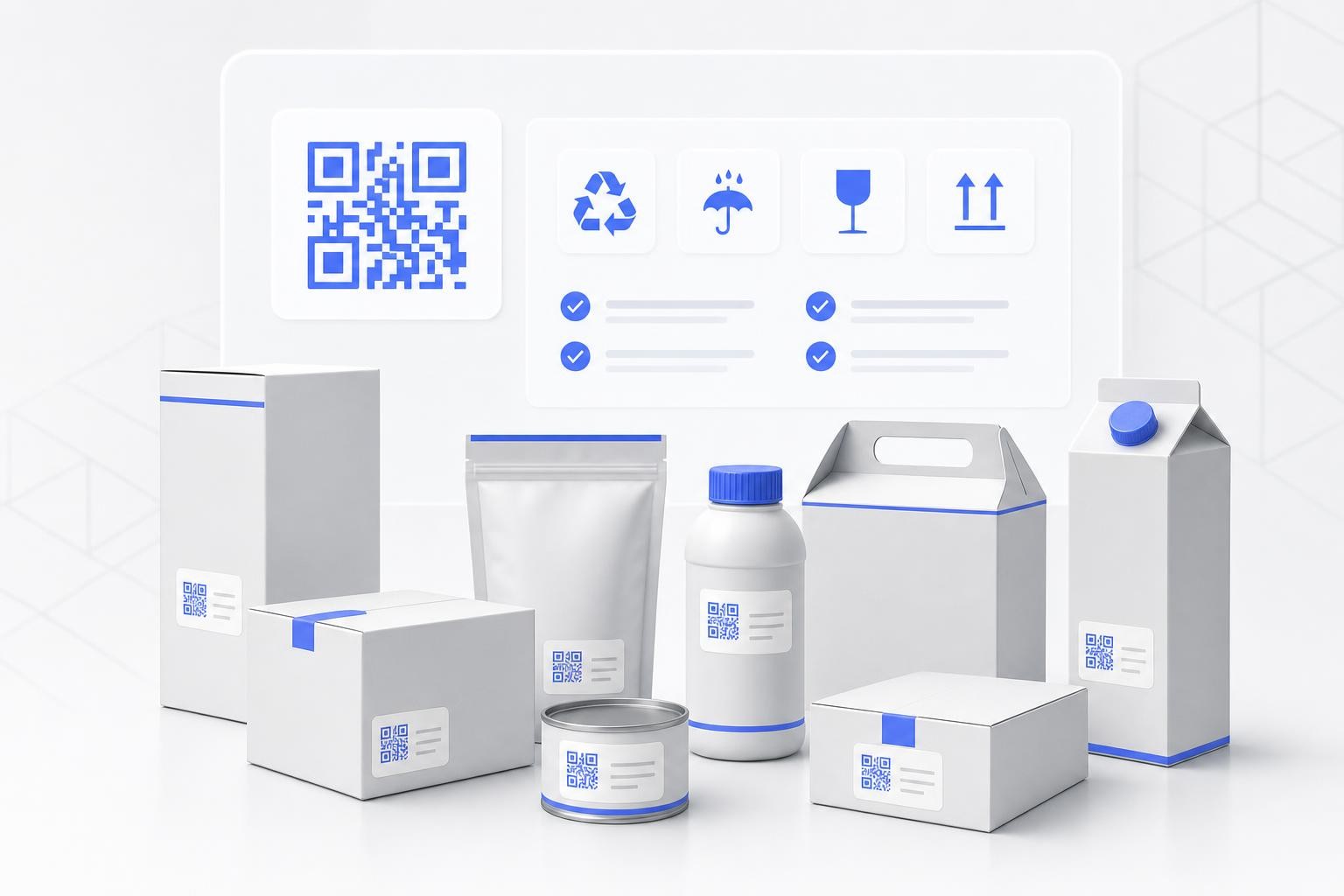
Most PPWR articles that packaging managers are reading right now focus on recyclability, recycled content targets, and EPR registration. Article 12 - the cornerstone of the new labeling requirements - tends to appear only as a footnote. That's a costly oversight: the labeling requirements apply to every single packaging SKU placed on the EU market from August 2026 onward, and the next escalation level arrives in 2028.
This post is not a general PPWR introduction. It delivers the article-by-article compliance checklist from Art. 12 and Annex VII - with concrete deadlines, exceptions, and an implementation roadmap you can plug directly into your project planning.
What Article 12 of the PPWR Actually Requires - and When
The PPWR (Regulation (EU) 2025/40) staggers the labeling obligations across two clearly distinct deadlines. Confusing the two risks either unnecessary upfront costs or a compliance gap right before 2028.
Stage 1: From August 12, 2026 - Immediately Effective Mandatory Information
From August 12, 2026, packaging must carry an identification feature (e.g., batch or serial number) as well as the name, brand, postal address, and electronic contact details of the producer. This information may be provided directly on the packaging, via QR code, or in accompanying documents - provided physical application is not feasible.
What this means in practice:
- Identification feature: Type, batch, or serial number for traceability purposes
- Producer information: Name/brand, postal address, email address or website
- Importer information: Where applicable, the importer's contact details in addition
- Language requirement: Text-based information must be available in all languages of the markets where the product is sold - selling in Denmark means labeling in Danish
Article 12(5) of the PPWR stipulates that labels (including QR codes) must be permanently affixed, clearly visible, and not easily removable.
One critical point that is frequently overlooked: QR codes may not be used under the PPWR as a complete substitute for mandatory information printed directly on the packaging - certain details must still appear on the physical packaging itself.
Stage 2: From August 12, 2028 - Harmonized EU Labeling
No earlier than August 12, 2028 - or 24 months after the relevant implementing acts enter into force, whichever is later - all packaging must carry harmonized, clearly legible labeling indicating material composition (Art. 12(6) and (7) of Regulation (EU) 2025/40).
This labeling is based on pictograms and must be accessible to people with disabilities. The existing national abbreviation systems under Directive 97/129/EC may no longer be used for packaging newly placed on the market.
Additional requirements from 2028 by packaging type:
| Packaging type | Additional labeling obligation |
|---|---|
| Compostable packaging | Indication of compostability, exclusion of home composting |
| Reusable packaging | Reusability label + QR code with return information |
| Packaging with recycled content | Disclosure of recycled content share (if voluntarily communicated: per applicable standard) |
| All packaging | Harmonized material composition pictogram |
For reusable packaging, a harmonized reusability label becomes mandatory from February 12, 2029; additional information on reuse must be accessible via a QR code or other open data carrier.
Annex VII: What Must Be Included in the Technical Documentation
Article 12 cannot be read in isolation. The labeling obligations are directly linked to the technical documentation required under Annex VII: only those who have complete, structured packaging data on hand can label correctly - and demonstrate in an audit that the information is accurate.
Annex VII requires, among other things:
- Description of the packaging and its components (materials, weights, layers)
- Evidence of recyclability and, where applicable, compostability
- Information on recycled content shares (including the calculation basis)
- References to applicable standards or technical specifications
- Declaration of conformity per Annex VIII
The practical challenge: companies still managing their packaging data in Excel spreadsheets, PDF datasheets, and ERP exports cannot build this documentation efficiently - let alone keep it current when materials or suppliers change.
Labelling without a data foundation is impossible. Article 12 requires information on material composition, recycled content, and reusability — data that must come directly from the technical documentation under Annex VII. Anyone who doesn't manage their packaging data in a structured way will be unable to label correctly or provide an auditable declaration of conformity.
EPR Labeling: The Third Building Block from 2027
Alongside the mandatory information under Art. 12(1)-(5) and the harmonized labeling from 2028, a third element is coming: from 2027, packaging registered in national EPR systems (e.g., in the US, France, or Germany) may be marked with an EPR symbol - delivered via QR code or other standardized digital marking technology. This symbol signals that the producer has fulfilled its EPR obligations.
The implication: a single QR code on the packaging will ultimately need to serve multiple layers of information - material composition, sorting instructions, recycled content share, reuse information, and EPR proof. This is not a design problem. It is a data management problem.
Your Implementation Roadmap: What to Do and When
The Five Most Common Mistakes in Art. 12 Implementation
Working with more than 300 enterprise customers, we see the same stumbling blocks time and again:
1. Treating the QR code as a full substitute The QR code supplements physical labeling - it does not replace it. Mandatory details such as producer information must appear directly on the packaging or in accompanying documents.
2. Underestimating language versions Selling in five EU markets means maintaining five language versions of all text-based information. This is not a translation project - it is a data management project that must be factored into artwork planning from the start.
3. Conflating 2026 and 2028 The immediately effective obligations (identification, producer information) and the harmonized pictograms (from 2028) are two separate compliance stages with distinct requirements. Mixing them up means either investing too early in artwork changes or too late in building the underlying data foundation.
4. Failing to involve supplier data The material composition information needed for labeling comes from the packaging supplier. Without structured supplier data, correct labeling in 2028 is impossible - regardless of how well internal data management is handled.
5. Treating labeling as a design task Art. 12 is not a job for the graphics department. It is a compliance task that requires clean packaging data, clearly defined responsibilities, and an audit-proof documentation system.
What This Means for Your Packaging Portfolio Planning
The labeling obligations under Art. 12 are not an isolated compliance topic. They are a direct reflection of the overall quality of your packaging data:
- No structured material data -> no correct material composition labeling from 2028
- No supplier connectivity -> no reliable recycled content disclosures
- No cross-SKU data foundation -> no scalable QR code infrastructure
- No artwork workflows -> no efficient rollout of language versions
Companies that structure their packaging data today are simultaneously building the foundation for the declaration of conformity under Annex VIII, EPR registration, and labeling under Art. 12. Those who wait until the implementing acts for the pictograms are published will have too little time left to build the data foundation.
 AI-generated image
Conclusion: Art. 12 Is a Data Problem, Not a Design Problem
The PPWR's labeling requirements are technically manageable - but only if the underlying packaging data is in order. The deadline to August 2026 for Stage 1 is already uncomfortably close. The deadline to 2028 for the harmonized pictograms sounds comfortable; it isn't. The implementing acts that will define the exact pictogram specifications are expected to be published only in 2026 or 2027 - leaving just 24 months to roll out changes across every packaging line.
Packaging managers who build their data foundation now will not be scrambling in 2028. Everyone else will be.