

Many companies are treating August 12, 2026 like a finish line. Declaration of Conformity done, labeling updated, registration filed - box ticked. But anyone reading the PPWR that way has fundamentally misread the regulation.
The EU Packaging and Packaging Waste Regulation (Regulation (EU) 2025/40) entered into force on February 11, 2025 and applies directly across all 27 member states from August 12, 2026 - [1]. But the August deadline is only the first stage of a multi-stage rocket. Delegated acts arriving between December 2026 and 2030 will reshape packaging design, supply chains, and data obligations from the ground up. Companies that build a clean data foundation today will have the advantage at every one of those steps. Companies that wait will be scrambling from scratch each time.
What takes effect immediately on August 12, 2026
The launch date brings three obligations that kick in with no transition period.
Declaration of Conformity under Annex VIII
From August 12, 2026, a valid PPWR Declaration of Conformity (DoC) must be in place for every type of packaging placed on the EU market - [2]. The declaration is grounded in Article 39 of the PPWR and follows the structure set out in Annex VIII. It is not a one-and-done document: it must be updated whenever the product or the regulatory framework changes - [3].
Any producer, importer, or distributor placing packaging on the market under their own name must issue the DoC themselves. Retention requirements are five years for single-use packaging and ten years for reusable packaging - [4].
Without a valid declaration of conformity, packaging may no longer be placed on the EU market from August 12, 2026. Violations can be penalized with fines of up to €200,000, sales bans, and cease-and-desist letters under competition law – BTL Rechtsanwälte.
Core labeling requirements
From August 2026, initial labeling requirements apply: packaging must carry information on material composition, recyclability, and disposal route - [5]. The harmonized consumer-facing pictograms come later: the European Commission must adopt an implementing act on material composition methodology by August 12, 2026; the full harmonized labeling requirements do not apply until August 12, 2028 - [6].
Registration obligations under the EPR system
Producers, importers, and - in certain configurations - online platforms must register in the national producer registers of each country where they sell. The PPWR establishes an EU-wide harmonized registration and reporting regime under extended producer responsibility - going forward, EU-harmonized data models apply with a fixed annual reporting deadline - [7].
Check now whether your declarations of conformity, material specifications, and registrations are ready for August 12.
Book a demoThe delegated acts: the roadmap to 2030
August 12 is the starting gun - but the decisions that will truly define the landscape come after it. Here are the four most important milestones:
December 2026: Recycled content methodology for plastics
By December 31, 2026, the European Commission must adopt delegated acts establishing sustainability criteria for plastic recycling technologies - [8]. In parallel, the Commission must establish by end of 2026 a methodology for assessing, verifying, and certifying the recycled content derived from post-consumer plastic waste originating in third countries.
What this means in practice: Any company that still lacks reliable data on recycled content in its plastic packaging will feel the pressure no later than this point. Suppliers from non-EU countries currently provide inadequate material information far too often - [7]. The methodology acts will define exactly what that proof needs to look like.
February 2027: Reusability standards
By February 12, 2027, the European Commission must adopt a delegated act establishing the minimum number of trips for reusable packaging - [1]. Only then will it be clear which packaging legally qualifies as "reusable" and what systems companies are required to operate.
Also in February 2027: the Commission will mandate European standards bodies to develop methods for measuring packaging minimization - [9].
January 2028: Design-for-Recycling criteria
This is the most consequential delegated act in the entire PPWR. By January 1, 2028, the European Commission must adopt delegated acts establishing Design-for-Recycling (DfR) criteria and recyclability performance classes (A, B, C) - [10].
The DfR criteria will assess: separability of components, efficiency of sorting and recycling processes, and the quality of the resulting recyclate - [11]. The grading thresholds are already written into the regulation text:
| Klasse | Recyclingfähigkeit (Gewichtsanteil) | Marktzugang ab 2030 | Marktzugang ab 2038 |
|---|---|---|---|
| A | ≥ 95 % | ✅ Erlaubt | ✅ Erlaubt |
| B | ≥ 80 % | ✅ Erlaubt | ✅ Erlaubt |
| C | ≥ 70 % | ✅ Erlaubt | ❌ Verboten |
| D/E | < 70 % | ❌ Verboten | ❌ Verboten |
Sources: [10], [11]
2030: Minimum recycled content for plastics
From January 1, 2030, mandatory minimum levels of post-consumer recycled (PCR) content apply to plastic packaging. Targets vary by packaging type: 30% for contact-sensitive PET packaging, 10% for other contact-sensitive plastic packaging, 30% for single-use beverage bottles, and 35% for all other plastic packaging - [12].
One critical distinction: only post-consumer recyclate (PCR) counts - post-industrial recyclate (PIR) does not satisfy PPWR requirements, even though many suppliers currently market it as "recycled content" - [13].
What the delegated acts mean for day-to-day operations
DfR criteria will fundamentally reshape packaging design
The DfR acts are not a bureaucratic formality - they will concretely determine whether a packaging format can remain on the EU market or not. Multi-component packaging (glass with metal lids and plastic film, composite cartons, shrink-wrap combinations) will face particular pressure: packaging that does not achieve recyclability class A, B, or C may no longer be placed on the EU market from 2030 - [14].
That means packaging decisions being made today - material selection, component design, adhesive choice, label substrate - have a direct bearing on compliance standing in 2030. A company that starts redesigning in 2027 will have almost no runway left for supplier switches, approval processes, and artwork updates.
Recycled content targets demand new supply chains
The PCR requirements from 2030 are not a design question - they are a procurement question. Food-grade PCR material is scarce: mechanical recycling reliably produces food-grade material only for PET; for other plastics, that assurance does not exist - [13]. Companies that start qualifying PCR suppliers in 2028 or 2029 will be buying in a market that has already been picked clean.
The methodology acts of December 2026 will also define how recycled content must be documented - which certificates are required, what traceability looks like, and what audit obligations apply. Companies without structured material data from their suppliers today will not be able to meet that burden of proof.
EPR fees will be tied to recyclability classes
From 2030, EPR fees will be eco-modulated by recyclability class: packaging in class A pays less, while classes D and E may not be sold at all - [15]. That makes the DfR class a direct cost driver - not just a compliance checkbox.
 AI-generated image
Why clean data makes all the difference today
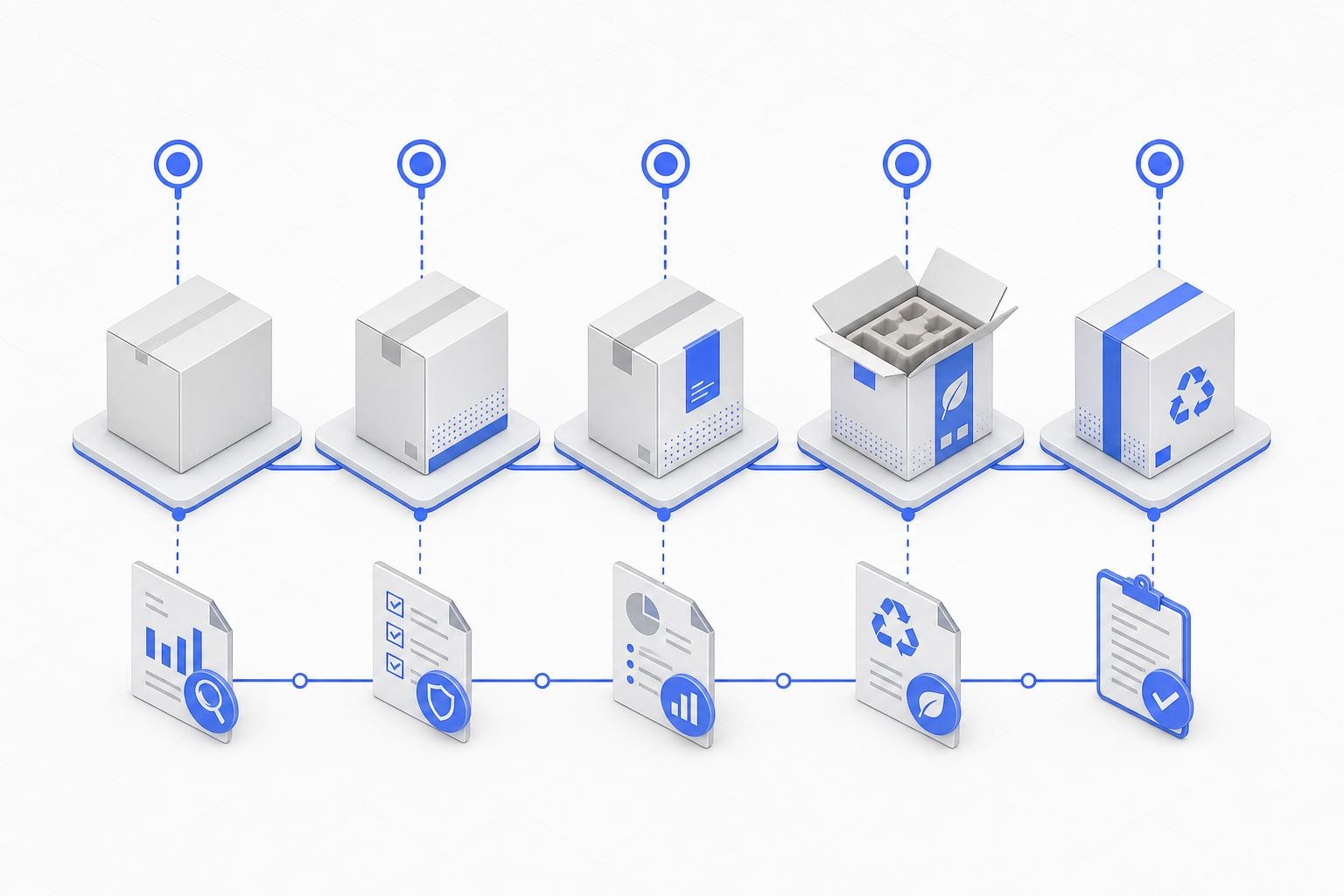
Every delegated act asks the same fundamental question: do you have the data to prove your packaging meets the new requirements?
- December 2026 asks about recycled content and its origin.
- February 2027 asks about trip counts and reuse systems.
- January 2028 asks about DfR classes and component separability.
- 2030 asks for PCR documentation by packaging type and production site.
Companies that don't hold this data in a structured, audit-ready system today - relying instead on spreadsheets and folders of PDFs - will be running a fire drill every time a new act lands. Companies that do will be able to treat each new act as confirmation of work already done.
Packa: A platform that scales with every new act
Packa was not built as a one-time compliance tool - it was built as a platform that scales with the PPWR.
Today, Packa covers the immediate August 2026 obligations: AI-powered digitization of material specifications, automated generation of Declarations of Conformity under Annex VIII, supplier management, and sustainability analysis (recyclability, CO₂, EPR).
Tomorrow - as the delegated acts arrive - Packa builds on that foundation: DfR scoring based on the criteria then in force, recycled content tracking with PCR documentation, and recyclability class monitoring across the entire packaging portfolio.
The decisive advantage: companies that structure their packaging data in Packa today won't need to build a new data foundation for each new act. The data is already there - it just needs to be extended with new fields and assessment logic.
Talk to our packaging experts about how to build your data foundation today so you're prepared for every delegated act through 2030.
Talk to packaging expertsThe bottom line: August 12 is the beginning, not the end
The PPWR is not a one-time task. It is a rolling compliance regime that runs through 2040, with each delegated act placing new demands on data, design, and supply chains.
Companies that treat the August deadline as an endpoint will discover by December 2026 that the next wave is already breaking. Companies that build a structured, audit-ready data foundation today will experience every subsequent step as confirmation of work already done - not as a new crisis.
The question is not whether the delegated acts are coming. It is whether you'll be ready when they arrive.