

If you've been in any packaging or compliance meeting in the past six months, you've heard it: "Maybe PPWR gets pushed back." The rumor has circulated in trade press, industry associations, and supplier conversations since mid-2025. It's understandable - the regulation is complex, the secondary legislation is still arriving, and 17 industry associations formally asked the European Commission for a delay.
The Commission said no. Here's the verified picture as of July 2026.
The Verdict: 12 August 2026 Is Not Postponed
Let's be direct. Regulation (EU) 2025/40 was published in the EU Official Journal on 22 January 2025, entered into force on 11 February 2025, and applies from 12 August 2026. That date has not changed.
In October 2025, EU Environment Commissioner Jessika Roswall made the Commission's position explicit in writing: the new obligations - including the revised producer definition under EPR - will apply as planned from 12 August 2026. The Commission did not budge despite a joint letter from 17 major industry associations warning of "serious practical problems."
On 10 June 2026, the European Commission formally published its Guidance Document on Regulation (EU) 2025/40 (Notice C/2026/3084) in the Official Journal of the EU. The guidance - first made available on 30 March 2026 - clarifies key definitions, PFAS restrictions, recyclability, and reuse provisions. Publishing implementation guidance six weeks before the application date is not the behavior of a regulator preparing to postpone.
Verified status as of 22 July 2026: The 12 August 2026 application date of Regulation (EU) 2025/40 is confirmed and has not been officially postponed. No legislative amendment, Council decision, or Commission proposal to delay the core application date has been adopted. Any claim to the contrary is unverified.
Myth vs. Fact
| Myth | Fact |
|---|---|
| "PPWR is being postponed to 2027." | The Commission explicitly ruled this out in writing (October 2025). The 12 August 2026 date stands. |
| "The secondary legislation isn't ready, so the regulation can't apply." | The core regulation applies regardless. Secondary acts define how certain requirements are measured - not whether they apply. |
| "There's a grace period for existing stock." | There is no general grace period. Packaging placed on the EU market after 12 August 2026 must comply. |
| "The labelling rules are delayed, so nothing is urgent." | Harmonized labelling implementing acts are now expected Q4 2026 - but the obligation to prepare a Declaration of Conformity (DoC) applies from day one. |
| "Recycled content targets don't kick in until 2030, so we have time." | The DoC, substance restrictions (PFAS, heavy metals), and recyclability assessments are all active from 12 August 2026. The 2030 targets require preparation now. |
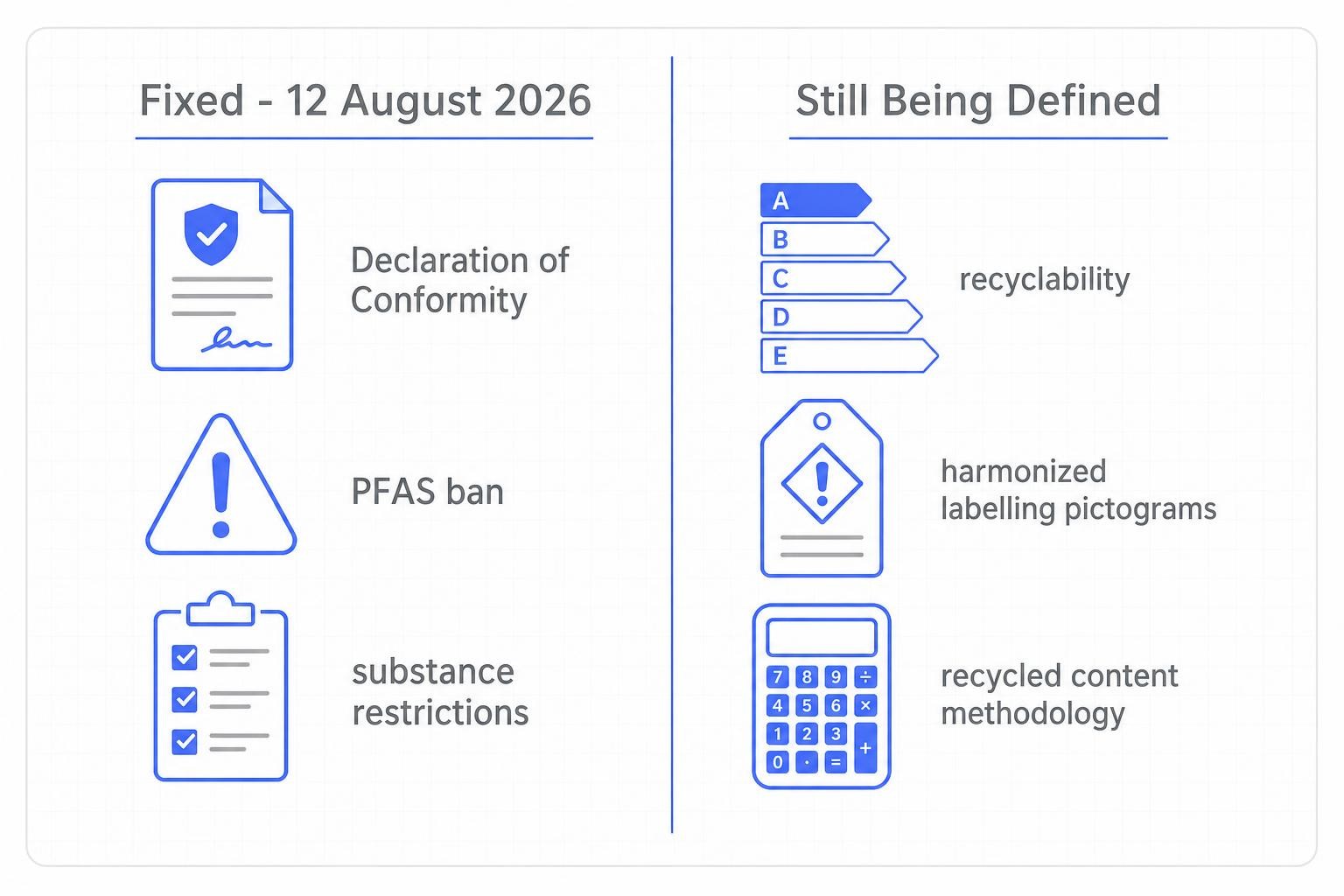
What Is Fixed vs. What Is Still Being Defined
This is the nuance that matters. The regulation itself is locked. What is still arriving is the secondary legislation - delegated and implementing acts that specify how certain provisions are measured and reported. These have their own, later deadlines built into the regulation text.
 AI-generated image
Fixed from 12 August 2026
- Declaration of Conformity (DoC): Every packaging unit placed on the EU market requires a signed DoC confirming compliance with Articles 5-12. No DoC, no market access. Technical documentation must be retained for five years (ten years for reusable packaging).
- PFAS restrictions in food-contact packaging: The PFAS concentration limits for food-contact packaging - any PFAS below 25 ppb, total PFAS below 250 ppb - apply from 12 August 2026 with no transitional period for existing stock.
- Heavy metals threshold: The 100 ppm combined limit for lead, cadmium, mercury, and hexavalent chromium applies from day one.
- Prohibited packaging formats: Certain single-use formats and unnecessary packaging are banned outright.
- Reusability criteria: The framework for assessing reusability applies from 2026; volume quotas phase in from 2030.
Still Being Defined (with later statutory deadlines)
- Recyclability performance grades (A-E): The Commission must adopt delegated acts establishing Design for Recycling criteria and recyclability performance grades by 1 January 2028. The grade-based market access requirements (only A, B, C permitted) then apply from 1 January 2030 or 24 months after those acts enter into force, whichever is later.
- Harmonized labelling implementing acts: Initially expected by August 2026, these are now due Q4 2026. The mandatory harmonized labels themselves apply from August 2028 at the earliest.
- Recycled content calculation methodology: Implementing and delegated acts on calculation and verification methodology for recycled content are expected by 31 December 2026.
- EU-level producer register: Planned to replace national systems by 2029; the transition path is still being defined.
- EPR fee modulation: Financial contributions modulated by recyclability performance grades apply 18 months after the relevant delegated and implementing acts enter into force - not from August 2026.
The key distinction: Secondary legislation being delayed does not delay the core regulation. It means the detailed methodology for certain requirements arrives later — but the obligation to comply with the underlying requirement is already in force. Companies that wait for every delegated act to be finalized before starting data collection will not have enough time.
Why Waiting Is the Real Business Risk
Here is the practical problem with the "let's wait and see" posture: packaging compliance has long physical lead times that no regulatory delay can compress.
Packaging redesign: Packaging redesigns and supply chain changes typically require 12-24 months of lead time. If your current packaging scores below recyclability grade C under any plausible assessment methodology, you need to start the redesign process now - not after the delegated acts are finalized in 2028.
Supplier data collection: The DoC is only as credible as the supplier data behind it. Collecting material composition, recycled content, and PFAS status data from a large supplier base takes months, especially when suppliers have their own backlogs. PFAS testing at accredited EU laboratories currently has lead times of 8-14 weeks, driven by demand from multiple regulatory programs running in parallel.
DoC preparation at scale: For companies with hundreds or thousands of packaging SKUs, generating audit-ready DoCs is not a one-week task. It requires structured data, a clear conformity assessment process, and a system that keeps documentation current every time materials, designs, or suppliers change.
Market surveillance is active from day one. After 12 August 2026, market surveillance authorities in all 27 EU member states can request documentation at any time. There is no grace period for non-compliance discovered after the fact.
The companies that treated the "postponement rumors" as a reason to delay are now operating at the outer edge of feasibility.
Your PPWR Readiness Check
Use this tool to assess where your organization stands and what actions are most urgent for your situation.
What Packa Customers Are Doing Right Now
Packa was built from 850+ real packaging projects with 300+ enterprise customers. The pattern we see among teams that are genuinely ready for 12 August 2026 is consistent:
- Centralized packaging data - all specs, materials, and supplier certificates in one auditable system, not scattered across PDFs and Excel files.
- Automated DoC generation - Packa generates Declaration of Conformity documents directly from structured spec data, eliminating manual assembly and version errors.
- Supplier data workflows - structured requests to packaging suppliers for material composition, recycled content, and PFAS status, with tracking and automated reminders.
- Portfolio-level recyclability mapping - understanding which packaging formats are at risk for the 2030 grade requirements, so redesign decisions can be made now with appropriate lead time.
The teams that are not ready share a different pattern: they were waiting for the postponement that never came.
Discuss your specific PPWR situation with a Packa expert — where you stand, what's urgent, and what a realistic path to compliance looks like for your portfolio.
Talk to a Packaging ExpertFrequently Asked Questions
Has PPWR been officially postponed as of July 2026?
No. The 12 August 2026 application date of Regulation (EU) 2025/40 has not been officially postponed. The European Commission confirmed this position in writing in October 2025 and reinforced it by publishing formal implementation guidance in June 2026.
Some delegated acts are delayed — does that mean I don't need to comply yet?
No. The core regulation applies from 12 August 2026 regardless of the status of secondary legislation. Delegated and implementing acts define the detailed methodology for certain requirements (e.g., recyclability grades, harmonized labelling pictograms) — but the underlying obligations are already in force. The Declaration of Conformity, PFAS restrictions, and substance limits all apply from day one.
When will the harmonized labelling implementing acts be published?
The labelling implementing acts were originally expected by August 2026 but are now due Q4 2026 according to EUROPEN. The mandatory harmonized labels themselves apply from August 2028 at the earliest — but companies should begin tracking material composition data at SKU level now, as this data underpins both the DoC and future labelling requirements.
When do recyclability performance grades (A–E) become mandatory?
The Commission must adopt the delegated acts establishing Design for Recycling criteria and recyclability performance grades by 1 January 2028. The grade-based market access requirements (only grades A, B, C permitted) then apply from 1 January 2030 or 24 months after those acts enter into force, whichever is later. However, packaging redesigns require 12–24 months of lead time, so planning must start now.
Is there a grace period for packaging produced before 12 August 2026?
There is no general grace period. Packaging placed on the EU market after 12 August 2026 must comply with PPWR requirements. The Commission's guidance confirms there is no transitional period for exhaustion of stocks regarding PFAS-containing food-contact packaging produced before that date.
How long does it take to prepare a PPWR Declaration of Conformity?
It depends on the size of your packaging portfolio and the quality of your existing supplier data. For companies with hundreds of SKUs and incomplete supplier data, the process can take several months. PFAS testing at accredited EU laboratories currently has lead times of 8–14 weeks. Packa automates DoC generation from structured spec data, reducing this significantly.