
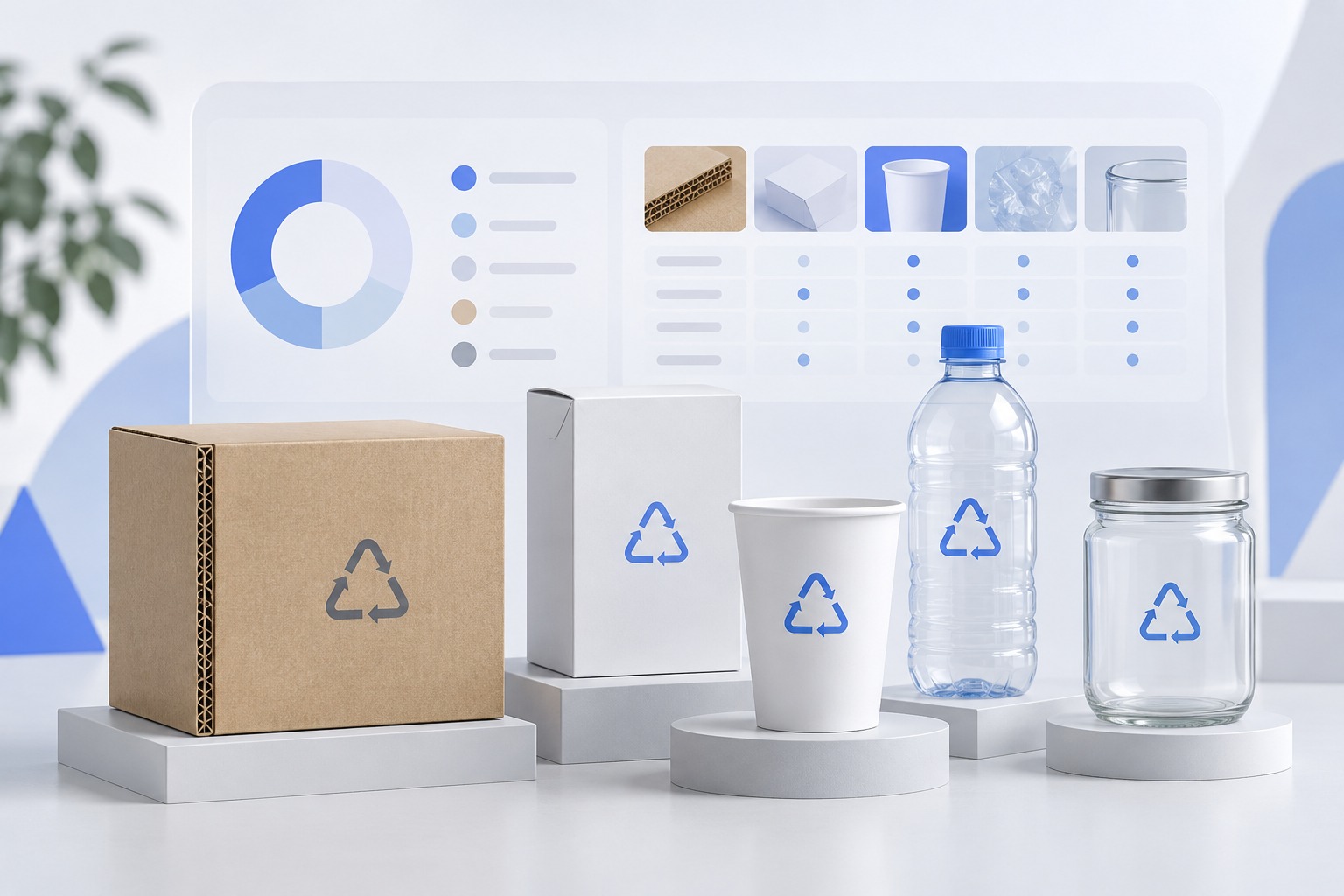
PAP 20 on a shipping carton, C/PAP 81 on a coffee cup, PET 1 on a bottle: the small codes on packaging tell you what material it is made of. Consumers often find them cryptic, and for packaging managers they raise practical questions: Do you have to print them? Which codes are allowed? And what happens when the EU Packaging and Packaging Waste Regulation (PPWR) introduces harmonised labelling?
This article explains the system behind the codes, includes the full code table, and shows what changes by 2028.
Where the codes come from
The basis is European Commission Decision 97/129/EC of 28 January 1997. It sets out a uniform identification system for packaging materials: one number and one abbreviation per material EUR-Lex, Decision 97/129/EC. The number ranges are grouped by material:
- 1 to 19: plastics
- 20 to 39: paper and board
- 40 to 49: metals
- 50 to 59: wood
- 60 to 69: textiles
- 70 to 79: glass
- 80 to 99: composites
The full code table
| Code | Material | Group |
|---|---|---|
| PET 1 | Polyethylene terephthalate | Plastic |
| HDPE 2 | High-density polyethylene | Plastic |
| PVC 3 | Polyvinyl chloride | Plastic |
| LDPE 4 | Low-density polyethylene | Plastic |
| PP 5 | Polypropylene | Plastic |
| PS 6 | Polystyrene | Plastic |
| PAP 20 | Corrugated fibreboard | Paper and board |
| PAP 21 | Non-corrugated fibreboard | Paper and board |
| PAP 22 | Paper | Paper and board |
| FE 40 | Steel | Metal |
| ALU 41 | Aluminium | Metal |
| FOR 50 | Wood | Wood |
| FOR 51 | Cork | Wood |
| TEX 60 | Cotton | Textile |
| TEX 61 | Jute | Textile |
| GL 70 | Colourless glass | Glass |
| GL 71 | Green glass | Glass |
| GL 72 | Brown glass | Glass |
| C/… 80 | Paper and board / miscellaneous metals | Composite |
| C/… 81 | Paper and board / plastic | Composite |
| C/… 82 | Paper and board / aluminium | Composite |
| C/… 83 | Paper and board / tinplate | Composite |
| C/… 84 | Paper and board / plastic / aluminium | Composite |
| C/… 85 | Paper and board / plastic / aluminium / tinplate | Composite |
| C/… 90 | Plastic / aluminium | Composite |
| C/… 91 | Plastic / tinplate | Composite |
| C/… 92 | Plastic / miscellaneous metals | Composite |
| C/… 95 | Glass / plastic | Composite |
| C/… 96 | Glass / aluminium | Composite |
| C/… 97 | Glass / tinplate | Composite |
| C/… 98 | Glass / miscellaneous metals | Composite |
Codes 7 to 19 are not assigned in the EU Decision. The frequently seen "O 7" or "Other 7" comes from the US resin identification code system and is not an official code under 97/129/EC.
The most common codes in practice
PAP 20 stands for corrugated fibreboard, i.e. typical shipping and outer cartons. PAP 21 covers other board without fluting, such as folding cartons for cereals or cosmetics. PAP 22 stands for paper, for example paper bags.
C/PAP 81 is a composite of paper or board and plastic in which paper predominates, such as coated coffee cups or paper packaging with a plastic film. C/PAP 84 combines paper, plastic and aluminium and is used in practice for beverage cartons.
For composites, the code combines "C/" with the abbreviation of the predominant material. Under the Decision, a composite is packaging made of different materials that cannot be separated by hand.
Is labelling mandatory?
In the EU, labelling is voluntary. Decision 97/129/EC explicitly provides for voluntary use; a binding introduction was possible but was never adopted EUR-Lex.
Germany follows the same approach, with one important restriction. Packaging may be marked with the defined numbers and abbreviations. But anyone who marks packaging may not use other numbers or abbreviations for the same materials. Since 12 August 2026, this rule has been set out in Section 4 of the Packaging Law Implementation Act (VerpackDG) and its Annex 2; previously it was Section 6 of the Packaging Act with Annex 5 Section 4 VerpackDG.
Other countries are stricter. Since 2023, Italy has required material codes on all packaging, including B2B packaging Bird & Bird. France requires its own sorting instructions with the Triman and Info-tri. See our article on the Triman logo.
Three common misconceptions
| Symbol | What many people think | What it actually means |
|---|---|---|
| Möbius loop (three chasing arrows) | The packaging is recyclable | A general recycling symbol with no legal statement about recyclability or actual recycling |
| Number inside an arrow triangle | A recycling promise | A material code. The US standard ASTM D7611 replaced the arrows with a solid triangle in 2013 for this reason |
| Green Dot (Grüner Punkt) | The packaging will be recycled | A trademark / licence mark. Not mandatory in Germany since 2009 and no statement about recyclability |
Sources: Resin identification code, Verbraucherzentrale.
There are also the ISO 1043 abbreviations (such as PE-HD instead of HDPE), which are mainly used for technical plastic parts. These are three different systems that partly overlap.
What changes under the PPWR
The EU Packaging and Packaging Waste Regulation replaces the voluntary codes with mandatory, harmonised labelling of material composition (Article 12 PPWR) PPWR Article 12:
- Content: information on material composition to help consumers sort waste.
- Format: pictogram-based and easy to understand, including for people with disabilities.
- From when: 12 August 2028 or 24 months after the implementing act enters into force, whichever is later.
- Exemptions: transport packaging (except e-commerce packaging) and packaging in deposit-return schemes.
- Sell-off: packaging manufactured or imported before the deadline may be sold for up to three years.
- Misleading marks are prohibited if they could mislead or confuse consumers about the information in the harmonised label.
Decision 97/129/EC is repealed with effect from 12 August 2028 (Article 70 PPWR). Its content is to be incorporated into the implementing act on harmonised labelling. That act was due by 12 August 2026 but has not yet been adopted; adoption is planned for the end of 2026.
The work is based on a technical proposal from the Joint Research Centre (JRC) of January 2026, which envisages pictograms with text and colour prodlaw.eu. It is not legally binding.
A further point concerns marks indicating participation in an EPR scheme: from 12 February 2027, under Article 12(9) PPWR, they are only permitted via a QR code or other digital marking. Whether and how this affects the Green Dot as a registered trademark has not yet been fully clarified.
For everything PPWR labelling requires, including QR codes, see our PPWR Article 12 labelling checklist and our guide to the PPWR QR code.
What to do now
Do your packs use only official codes under 97/129/EC or Annex 2 VerpackDG? Unofficial abbreviations are not permitted in Germany.
PPWR labelling requires you to know the material of every component, including composites.
For C/ codes, the predominant material decides. Document the weight shares.
Reserve space for the harmonised label and avoid marks that could be considered misleading in future.
Italy and France already have mandatory labelling requirements today.
Frequently asked questions
What does PAP 20 mean?
PAP 20 stands for corrugated fibreboard, such as shipping and outer cartons.
What is the difference between PAP 20, PAP 21 and PAP 22?
PAP 20 is corrugated fibreboard, PAP 21 is other board without fluting (e.g. folding cartons), and PAP 22 is paper.
What does C/PAP 81 mean?
A composite of paper or board and plastic in which paper predominates, for example coated paper cups.
Do I have to print recycling codes on my packaging?
In Germany and the EU, it is currently voluntary. But in Germany, if you do mark packaging, you may only use the official codes. Italy makes the codes mandatory. Under the PPWR, harmonised material labelling becomes mandatory from August 2028 at the earliest.
Does the Möbius loop mean the packaging is recyclable?
No. It is a general recycling symbol with no legally binding statement about recyclability.
Labelling starts with data
Whether it is a voluntary material code, Italian environmental labelling or the future PPWR label, every variant requires the material composition of every packaging item and component to be known and documented. This is exactly where many companies lack reliable data.
This article provides a general overview as of October 2026 and does not constitute legal advice. The implementing act on harmonised labelling under Article 12 PPWR had not yet been adopted at the time of writing.