
Many packaging managers know that the PPWR requires a QR code on packaging. What far fewer know is exactly which data points must sit behind it, which technical standard governs it - and why that QR code is the first building block of a Digital Product Passport. This guide provides concrete answers.
What Article 12 of the PPWR Actually Requires
The PPWR (Regulation (EU) 2025/40) sets out labeling requirements for packaging in Chapter III. Article 12 is the centerpiece - and it is more nuanced than it appears at first glance.
Important upfront: A QR code does not replace physical labeling. While the PPWR mandates QR codes and other data carriers, certain information and symbols must still be permanently printed or engraved on the packaging itself. Using QR codes as a substitute for printed labels is not permitted under the PPWR.
The Three QR Code Obligations at a Glance
The PPWR does not define a single, one-size-fits-all QR code. Requirements differ depending on packaging type and timeline:
1. Reusable Packaging (from February 12, 2029) From February 12, 2029, reusable packaging must be labeled as reusable, and further information about the reuse system must be made accessible via a QR code or another open, standardized digital data carrier. This carrier must enable tracking of the packaging and the calculation of rotation counts and trip numbers - or, where that calculation is not feasible, provide an average estimate.
2. EPR Labeling (from February 12, 2027) From 2027, packaging covered by a specific EPR scheme (e.g., in France or Germany) may be labeled in the relevant territory with "a symbol in a QR code or another standardized, open, digital marking technology" to indicate that the producer meets EPR requirements.
3. Substances of Concern (from August 12, 2028) Packaging containing substances of concern must, from August 2028, be labeled with standardized, open, digital marking technologies. The data carrier must include at minimum the name and concentration of the substance of concern present.
4. Harmonized Labeling and Data Carrier (from August 12, 2028) From August 12, 2028, all packaging placed on the EU market will carry a harmonized label. The Commission is finalizing pictograms covering material composition, sorting instructions, and reuse status. National labels (e.g., the Green Dot, Triman) will be replaced by an EU-wide system. A data carrier (QR code or equivalent) will form part of the label and link to digital information including recycled content, substances of concern, and end-of-life guidance.
Timeline at a Glance:
- August 12, 2026 – PPWR applies, Declaration of Conformity (DoC) required
- February 12, 2027 – EPR labeling via QR code permitted
- August 12, 2028 – Harmonized label + data carrier for Substances of Concern and recycled content
- February 12, 2029 – QR code mandatory for reusable packaging
- January 2030 – Recyclability Grades A–C as a market access requirement
Which Data Points Must Sit Behind the QR Code
This is the question that generates the most uncertainty in practice. The PPWR introduces a Digital Product Passport (DPP) requirement for packaging. The DPP is a dataset linked to the packaging via a QR code or similar digital carrier, containing detailed information on materials, recyclability rating, recycled content, and end-of-life guidance. The DPP builds on data that companies already need for recyclability assessments and EPR reporting - but requires that data to be machine-readable and accessible by scan.
Based on the regulatory texts and published guidelines, a PPWR-compliant data carrier must include the following mandatory data points:
| Datenpunkt | Rechtsgrundlage | Pflicht ab | Hinweis |
|---|---|---|---|
| Materialzusammensetzung (Polymer, Klebstoffe, Tinten, Beschichtungen) | Art. 12, Anhang VII | Aug. 2028 | Bei Mehrschichtverpackungen: Gewichtsanteil je Material |
| Recyclingfähigkeitsgrad (A–E) | Art. 6 + Art. 12 | Aug. 2028 | Basiert auf harmonisierten EU-Kriterien |
| Recyclinganteil (% Rezyklat) | Art. 7 + Art. 12 | Aug. 2028 | Verifizierte Berechnung nach Methodik gem. Art. 7(8) |
| Stoffe von Bedenken (Name + Konzentration) | Art. 12(7) | Aug. 2028 | Inkl. PFAS-Angaben |
| Sortierhinweise für Verbraucher | Art. 12 | Aug. 2028 | Sprachlich je Verkaufsland |
| Wiederverwendungsinformationen + Umlaufzählung | Art. 12(2) | Feb. 2029 | Nur für Reusable Packaging |
| EPR-Compliance-Symbol | Art. 12(9) | Feb. 2027 | Optional, länderspezifisch |
| Hersteller-Kontaktdaten | Art. 15 | Aug. 2026 | Kann auf QR-Code oder Begleitdokument |
Label information and information made accessible via QR codes must be provided in the official EU languages of the member states where the product is sold. Companies selling or distributing in Denmark, for example, must provide labels and digital information in Danish.
The Technical Standard: GS1 Digital Link
The PPWR mandates "standardized, open, digital data carriers" - and in practice, the industry is converging on one standard: GS1 Digital Link.
The technical stack gaining traction across the industry: ISO/IEC 18004 for QR code symbology, GS1 Digital Link for URL syntax, and the EU DPP backbone for registry and identity.
What does GS1 Digital Link actually do?
Using the GS1 standard means more than simply providing a URL to scan - it also delivers GS1 identifiers, the same ones the industry relies on today. The brand owner can redirect from the GS1 Digital Link URI to any number of digital information sources, all from a single barcode symbol.
Importantly, digital content can be continuously updated by the brand owner without changing the QR code on the packaging - meaning packaging or artwork does not need to be reprinted for new regulatory updates.
GS1 provides identification and linking structures (e.g., GTIN, GLN, Digital Link QR codes) and is one of the most widely recognized open international standards for identification and data exchange in the context of the Digital Product Passport.
Minimum Technical Requirements for the QR Code
- Symbology: ISO/IEC 18004 (QR code) or Data Matrix
- URL syntax: GS1 Digital Link URI (structured path approach)
- Identifier: GTIN as the core element, supplemented by lot/batch or serial number
- Resolver: Context-based routing (consumer, recycler, regulatory authority)
- Hosting: For PPWR purposes, a retention obligation of 5 years applies to single-use packaging and 10 years to reusable packaging
- Placement: Where both legacy 1D barcodes and new QR codes appear on the same packaging, they must be placed within 50 millimeters of each other to prevent double-scanning.
One code, many use cases: GS1 Digital Link makes it possible to use the same QR code for PPWR labeling, EPR compliance, consumer information, and — when relevant — the Digital Product Passport under ESPR. This saves space on packaging and prevents the proliferation of multiple codes.
The Connection to the Digital Product Passport (DPP)
This is the most strategically significant decision facing packaging managers in 2026.
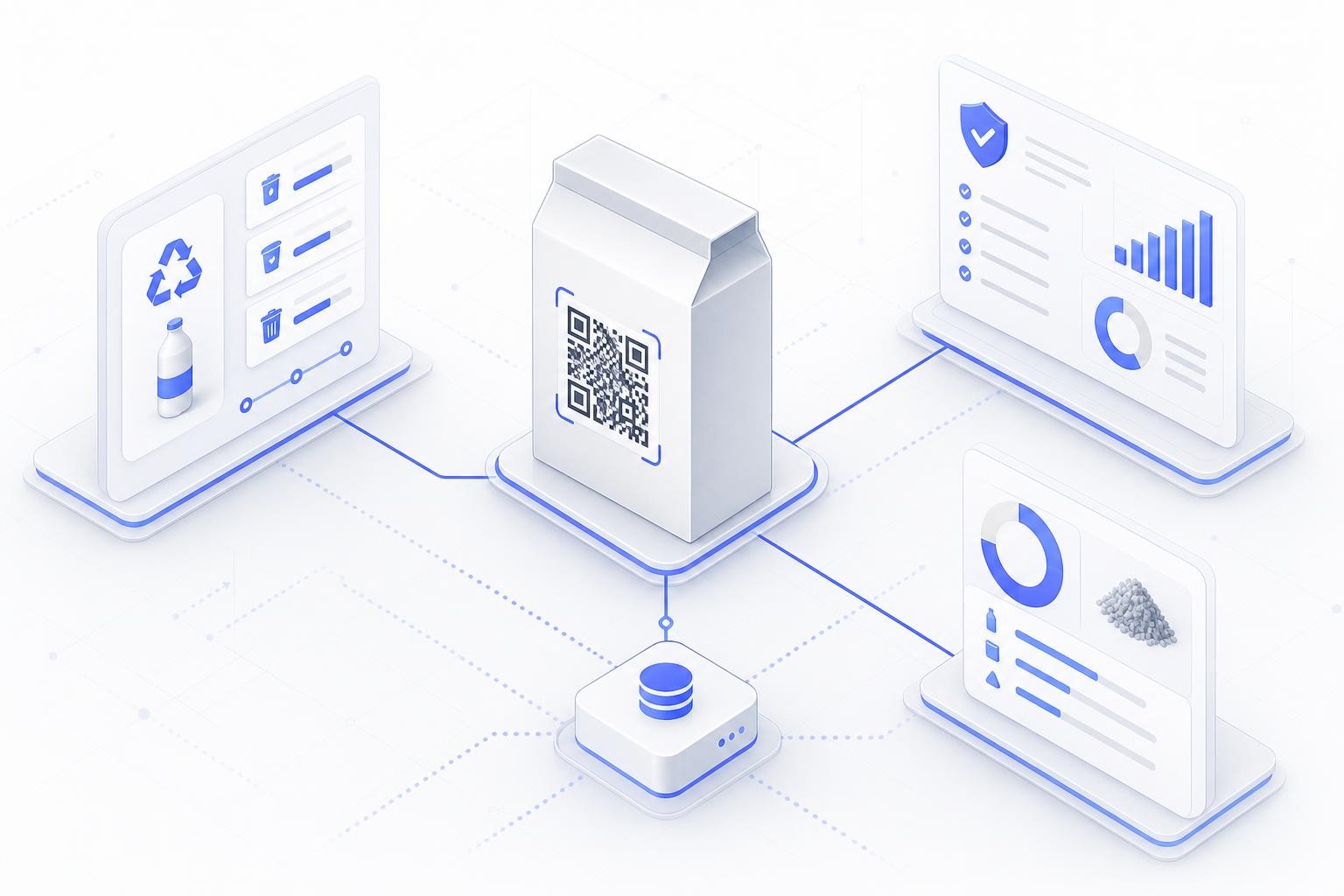
The PPWR and the DPP framework under the ESPR are running on parallel tracks that converge on a shared architecture: a data carrier (typically a QR code) that holds structured information about a product or its packaging. For manufacturers, the question is not whether to achieve PPWR or DPP compliance - it is whether to build two separate systems or one integrated passport.
From an implementation perspective, this means companies preparing for the DPP do not need to build an entirely separate technical stack for PPWR. Both regulations target the same outcome: product information that is structured, verifiable, machine-readable, and accessible to consumers, market surveillance authorities, and supply chain partners.
The master data model should cover a unified product and packaging schema encompassing material composition, recycled content, PFAS test results, substances of concern, end-of-life routing, and reuse status.
 AI-generated image
Implementation Guide: 5 Steps to a PPWR-Compliant QR Code Infrastructure
Build a matrix: rows = SKU families, columns = PPWR obligations by deadline (Aug. 2026: DoC; Feb. 2027: EPR symbol; Aug. 2028: data carrier + harmonized label; Feb. 2029: reusable QR code). Prioritize by volume and risk.
For each packaging type: material composition (including weight percentages), recyclability grade, recycled content, PFAS status, and Substances of Concern. This data must come from suppliers' technical data sheets (TDS) — structured, not as PDF scans.
Ensure a GTIN exists for each packaging type (GS1 membership required). Set up a GS1 Digital Link URI. Configure a resolver that delivers the correct view depending on user context (consumer, recycler, authority). Make a hosting decision: brand-hosted, solution provider, or registry.
Generate the QR code per ISO/IEC 18004. Verify print quality using an ISO/IEC-compliant verifier (grading A–F). Observe the 50 mm rule relative to existing EAN/GTIN barcode placement. Test scannability across all intended printing processes (flexo, digital, offset).
Set up the data model so that updates (e.g., new recyclability assessment, changed supplier) are possible without artwork changes. Retention periods: 5 years for single-use packaging, 10 years for reusable packaging. Keep documentation retrievable for market surveillance authorities within 10 days.
The Data Problem Trap: Why Spreadsheets Fall Short
Manual spreadsheets cannot track PFAS test results, recycled content percentages, and declarations of conformity across hundreds of SKUs in a compliance-ready format.
That is the real bottleneck. The QR code itself is a solvable technical problem - the challenge is the data layer behind it. Companies still managing material compositions in PDFs and ERP exports will not be able to structure the required data points for the carrier in time.
The PPWR requires that technical documentation be made available to market surveillance authorities within 10 days.
What a software solution must deliver to support PPWR-compliant QR code infrastructure:
- AI-powered TDS digitization: Automatically convert technical data sheets from PDFs, Excel, and ERP exports into structured, auditable data points
- Central packaging data model: A single source of truth for material composition, recyclability, recycled content, and substances of concern
- Supplier data flow: Structured requests to suppliers that feed directly into the data model
- DoC generator: Automatic generation of the Declaration of Conformity from existing specification data
- Audit trail: Versioned documentation that satisfies regulatory authority requests within 10 days
Your packaging portfolio spans dozens or hundreds of SKUs — and the data points required for the PPWR QR code are scattered across suppliers, PDFs, and ERP systems. Talk to our experts about how Packa structures this data and gets your QR code infrastructure compliance-ready.
Talk to an ExpertInteractive Check: Which QR Code Obligations Apply to Your Packaging?
Not every packaging type is subject to the same requirements. Use this check to identify your specific obligations:
Conclusion: Build the Data Foundation Now - Not the QR Code
The QR code on the packaging is the visible end of a long data chain. DPP requirements under the ESPR will require packaging to carry machine-readable data on material composition, recyclability, and environmental footprint - data that must originate from verified supply chain sources. Companies without digital traceability systems will struggle to populate DPPs with credible, auditable data.
Companies that structure their packaging data in 2026 and 2027 will not be racing against the clock in 2028 and 2029. Those who wait until the delegated acts are finalized will have too little time to gather data from suppliers.
The first step is not choosing a QR code generator. The first step is a structured, audit-ready packaging data model.