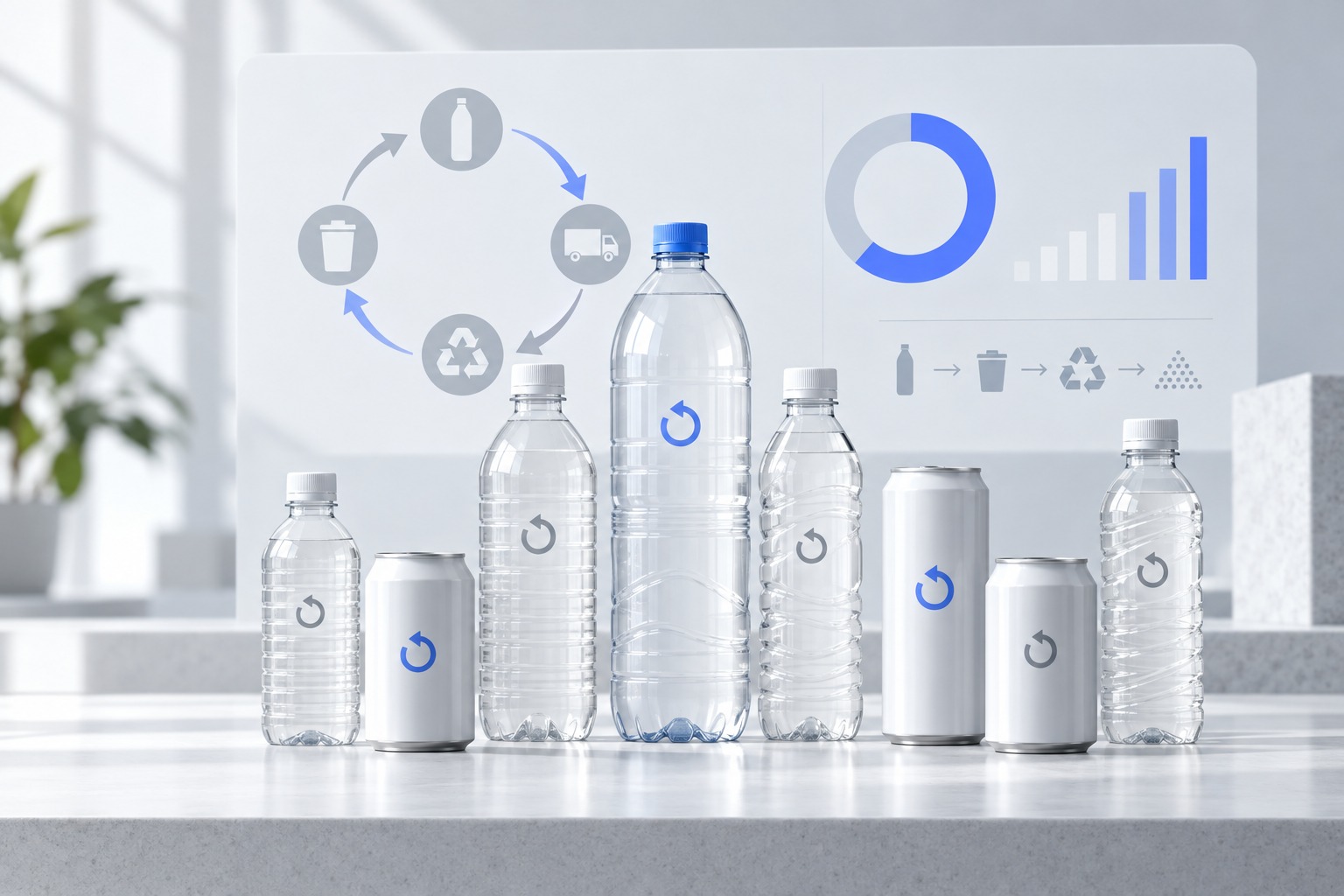
Germany has charged a deposit on single-use beverage packaging since 2003. What started as a "can deposit" now covers almost all single-use plastic bottles and all beverage cans, and since 2024 milk drinks in plastic bottles as well. With the Packaging Law Implementation Act (VerpackDG), the legal basis changed in August 2026, and the EU Packaging and Packaging Waste Regulation (PPWR) will make deposit return systems mandatory across the EU from 2029.
This article explains which packaging carries a deposit, what producers, importers and retailers have to do, and what the PPWR means for companies that also sell beverages in other EU countries.
The legal basis: Section 46 VerpackDG
Since 12 August 2026, the deposit obligation has been set out in Section 46 VerpackDG; previously it was Section 31 of the Packaging Act Section 46 VerpackDG. In substance, little has changed:
- Whoever first places filled single-use beverage packaging on the market must charge a deposit of at least 25 cents, including VAT, per unit.
- Every subsequent distributor passes the deposit on at every stage of trade down to the end customer.
- The first distributor must label the packaging as subject to a deposit permanently, clearly legibly and visibly before it is made available in Germany.
- It must participate in a nationwide deposit system.
Which packaging carries a deposit
In principle, the deposit applies to single-use beverage packaging with a fill volume of 0.1 to 3.0 litres. For plastic bottles and cans, this applies with virtually no exceptions; for other materials, it depends on the beverage.
| Packaging / beverage | Deposit required? | Note |
|---|---|---|
| Single-use plastic bottles (0.1 to 3 l) | Yes, regardless of contents | Since 2022 also for juice, wine and spirits in PET |
| Beverage cans (0.1 to 3 l) | Yes, regardless of contents | Since 2022 without exceptions |
| Milk and milk drinks in plastic bottles | Yes | Since 1 January 2024 |
| Beer, water, soft drinks in single-use glass | Yes | Standard case |
| Wine, sparkling wine, spirits in glass | No | Beverage exemption only applies outside plastic and cans |
| Juice, nectar, milk in glass | No | Beverage exemption |
| Beverage cartons (brick, gable top, cylinder) | No | Explicitly exempt |
| PE pouches and stand-up pouches | No | Explicitly exempt |
| Below 0.1 l or above 3 l | No | Outside the scope |
The exemptions for certain beverages such as wine, spirits, milk or juice do not apply to plastic bottles and cans. Wine in a PET bottle or juice in a can therefore carries a deposit; in a glass bottle or beverage carton it does not ZSVR, deposit obligation.
How the deposit obligation has evolved
Source for the timeline: DPG, legislative changes.
What producers and importers must do
The first distributor is whoever first places the filled beverage packaging on the market in Germany: the filler, or the importer bringing beverages into Germany from abroad. The nationwide deposit system is run by DPG Deutsche Pfandsystem GmbH. It sets the framework and organises deposit clearing between producers and return points DPG, beverage producers and importers.
A Global Location Number (GLN) from GS1 as your company identifier.
Sign the DPG terms of participation and pay the participation fee.
Register with your GLN and a GTIN (8 or 13 digits) assigned exclusively to the German market.
The DPG mark with security ink and barcode. Only certified can manufacturers and approved label printers may print it.
Usually via a clearing service provider that handles the deposit amounts.
Registration and system participation: Packaging subject to a deposit must also be registered in LUCID. It is exempt from participation in a dual system Section 11 VerpackDG, but its outer packaging, such as shrink film or trays, usually is not. How to draw the line is explained in our article on packaging subject to system participation.
New under the VerpackDG: producers of packaging subject to a deposit will also need authorisation from the Central Agency Packaging Register or must transfer their obligations to an authorised organisation. According to practitioners, a transition period runs until the end of 2027. Check the details in Sections 19 and 68 VerpackDG.
What retailers must do
Distributors must take back empty packaging subject to a deposit free of charge at the point of handover or in its immediate vicinity and refund the deposit. No deposit is refunded without returning the packaging.
- The take-back obligation is limited to the material types the retailer stocks itself.
- Shops with less than 200 square metres of sales area only have to take back the brands they sell themselves.
- For vending machines and distance selling, reasonable return options must be offered within a reasonable distance.
- In stores and online listings, beverages must be labelled "EINWEG" (single-use) or "MEHRWEG" (reusable), at least the size of the price label.
Fines
Failing to charge a deposit or to take packaging back can be fined up to EUR 100,000. Failing to register can also be fined up to EUR 100,000 Section 66 VerpackDG. The authorities of the German federal states are responsible for enforcement.
What the PPWR requires from 2029
The EU Packaging and Packaging Waste Regulation makes deposit return systems mandatory across the EU. Under Article 50 PPWR, Member States must by 1 January 2029 separately collect at least 90 percent of single-use plastic bottles and single-use metal beverage containers up to 3 litres and set up deposit return systems to do so PPWR Atlas, Article 50.
- Excluded are wine, aromatised wines, spirits and dairy products.
- Optional exemptions: Member States may exempt containers below 0.1 litres and beverages opened, consumed and returned in hospitality settings.
- Country exemption: A Member State can be exempted if it reaches a collection rate of at least 80 percent in 2026 and submits an implementation plan by 1 January 2028.
- Minimum requirements: Annex X of the PPWR sets minimum standards for new deposit systems, for example on governance, deposit level and take-back by retail.
Little changes for Germany. Return rates in the German single-use deposit system are 96 percent and higher, with around 20 billion units returned each year German Environment Agency, Texte 66/2026. The existing system already meets the PPWR requirements.
For companies supplying other EU countries, a lot changes: countries without a deposit system must introduce one by 2029. Anyone selling beverages across Europe needs to prepare for new national deposit systems with their own labelling, GTIN rules and participation requirements.
In addition, Article 29 PPWR sets reuse targets for beverages from 2030. See our article on PPWR 2030: reuse targets, reuse obligations and minimum recycled content.
Frequently asked questions
How much is the single-use deposit in Germany?
At least 25 cents per unit, including VAT.
Does juice in a plastic bottle carry a deposit?
Yes. Since 2022, single-use plastic bottles and cans carry a deposit regardless of the beverage. The juice exemption only applies to glass and beverage cartons.
Since when has milk in plastic bottles carried a deposit?
Since 1 January 2024. This also applies to milk-based mixed drinks and drinkable dairy products such as kefir or drinking yoghurt in plastic bottles.
Do I have to join the DPG system as an importer?
Yes. Anyone bringing beverages in single-use packaging subject to a deposit into Germany for the first time is the first distributor and must participate in the nationwide deposit system, including the DPG marking and a German GTIN.
Do I also have to license packaging subject to a deposit with a dual system?
No, single-use beverage packaging subject to a deposit is exempt from system participation. LUCID registration is mandatory, however, and outer packaging such as film or trays usually has to be licensed.
Related reading
- Which Packaging Is Subject to System Participation in Germany?
- Packaging Act 2026: VerpackDG and PPWR
- PPWR 2030: Reuse Targets, Reuse Obligations and Minimum Recycled Content
Keeping beverage portfolios under control across Europe
Deposit obligations, system participation, reuse targets and new deposit systems in other EU countries: for beverage producers, more and more obligations depend on which packaging is sold in which country with which contents. Maintaining this information in a structured way per item and market keeps you in control.
This article provides a general overview as of October 2026 and does not constitute legal advice. The VerpackDG, the PPWR and the requirements of DPG Deutsche Pfandsystem GmbH in their current versions are authoritative.