

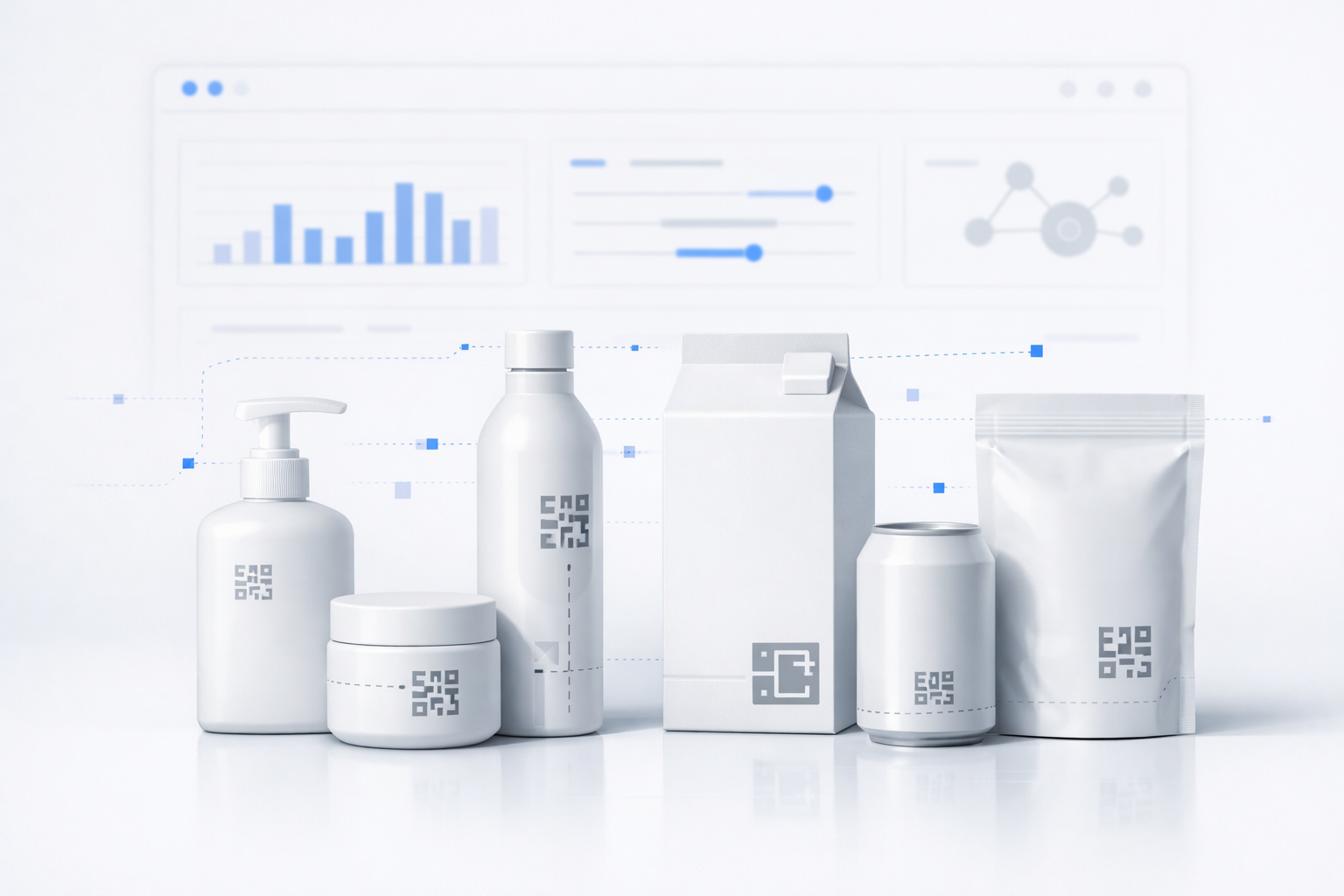
Two regulatory objectives, one data foundation - that is the central strategic opportunity many companies are still missing. From 12 August 2026, PPWR Article 5 will ban PFAS in food-contact packaging above defined limit values - at the same time, the Digital Product Passport (DPP) is emerging as the next major EU requirement. Treating these two requirements in isolation wastes significant efficiency potential. Because: The data you are collecting today for PFAS compliance is exactly the data you will need tomorrow for the DPP.
This article shows how to tackle both regulatory goals with a single data infrastructure - and how digital packaging management makes the decisive difference.
Why PFAS and DPP Rely on the Same Data Foundation
At first glance, PFAS compliance and the Digital Product Passport look like two completely separate topics. On closer inspection, however, they share a common core: structured, complete, and traceable product data at item level.
Wherever a packaged product requires a Digital Product Passport - for example under the ESPR - the packaging data should be included in the DPP. Concretely, this means: PFAS documentation, material composition and substance data gathered for your PPWR compliance preparation flow directly into the DPP.
Article 12 of the PPWR provides for the use of digital marking technology - from 1 January 2030 this technology will be mandatory to indicate the content of Substances of Concern (SoC) in packaging.
PFAS are explicitly classified as Substances of Concern in this context. Article 5 of the PPWR obliges the Commission to examine measures for Substances of Concern. Manufacturers and users of non-food packaging should be aware that certain PFAS are classified as SoC and are likely to face further restrictions in the future.
What the DPP Requires in a Packaging Context
The Digital Product Passport is a structured, machine-readable data set that makes sustainability and compliance information accessible across the entire product life cycle. It is accessed via a data carrier - typically a QR code - directly on the product or its packaging, and replaces scattered spreadsheets, supplier PDFs, and unstructured documents with a single, verifiable source of truth.
The DPP was introduced by the Ecodesign Regulation for Sustainable Products (ESPR) and serves as a digital tool to ensure traceability and transparency along the entire value chain. Each DPP is linked to a unique product identifier and enables traceability from the manufacturer to end-of-life.
For FMCG packaging owners, this means:
- Material composition of all components including coatings, adhesives, and additives
- Substances of Concern with concentration data (including PFAS)
- Recyclability and recycled content at item level
- Evidence, certificates, and test reports as linked documents
- Unique product identification for traceability
Companies must provide reliable product-related data that covers material composition, Substances of Concern, environmental performance characteristics, durability properties and end-of-life information. This information must be structured, precise and digitally accessible in line with the interoperability requirements of the ESPR framework.
The DPP Rollout: What FMCG Companies Need to Know Now
The Commission must define technical specifications and create a central DPP registry by July 2026 to support enforcement, customs checks, and market surveillance.
The rollout will take place in stages:
- 2026: Iron and steel products as the first category with mandatory DPP
- 2027: Aluminium, textiles and tyres; from 18 February 2027, battery passports will be mandatory for all traction and industrial batteries over 2 kWh
- 2028-2030: Gradual integration of packaging and FMCG categories
Companies should assess their PPWR compliance in the context of related EU frameworks - including the upcoming Digital Product Passport and the Green Claims Directive.
For FMCG packaging, mandatory DPP requirements are expected from 2028-2030 at the earliest. Those who structure their packaging data now will not only be PPWR-ready, but will also lay the foundation for a smooth DPP rollout.
5 Steps to an Integrated PFAS and DPP Data Foundation
The good news: you do not need to set up two parallel data projects. PFAS compliance and DPP preparation can be efficiently combined through a unified approach.
Where Companies Typically Struggle Today
In reality, most companies still lack sustainability data in a structured, machine-readable, and interoperable format. Instead, they rely on scattered supplier documents, ad hoc lifecycle assessments, manual processes, and static product reports.
The consequence for PFAS compliance is very concrete: The PPWR sets three PFAS limits for food-contact packaging: 25 ppb for individual non-polymeric PFAS, 250 ppb for the total sum of all non-polymeric PFAS - and anyone who cannot prove compliance with these limits risks losing market access from 12 August 2026.
Typical data gaps Packa customers identify during onboarding:
- Missing substance information for coatings and laminates: suppliers often provide only generic material information but no PFAS-specific declarations
- Decentralised documentation: PFAS test reports are stored across different departments - with no central access
- No structured data format: information in PDFs and emails - not machine-readable and therefore not DPP-ready
- Incomplete version control: no traceability as to which specification was valid at which point in time
Many companies still do not have reliable data on material composition, recycled content or chemicals. On top of this comes the complexity of global supply chains: suppliers are spread across many regions - with varying levels of data maturity and awareness of regulatory requirements.
Use the interactive tool below to assess how robust your packaging data actually is:
How Packa Connects PFAS Compliance and DPP Preparation
The Packa platform for digital packaging management serves both regulatory goals with a central data foundation. Specifically, Packa supports:
PFAS compliance today:
- AI-powered digitisation of existing packaging specifications (from Excel, PDF, ERP exports)
- Automated supplier requests for PFAS declarations and test reports
- Data gap analysis: Packa typically identifies 30-70% missing substance data in the first step
- Automated compliance check against PPWR limits and creation of Declarations of Compliance (DoC)
DPP preparation for tomorrow:
- All captured data is structured, versioned and uniquely linked to a packaging ID
- Machine-readable data formats enable future mapping into DPP-compliant structures
- Audit-ready documentation: complete evidence trail for substance data and supplier declarations
- Centralised data management instead of scattered file servers and email chains
The link to the PPWR Declaration of Conformity is particularly important: packaging must undergo a conformity assessment procedure and receive an EU Declaration of Conformity confirming that the packaging meets sustainability requirements - including the use of specific substances such as PFAS. This DoC documentation forms the technical core of the future DPP.
You can find more on the connection between DoC and DPP in our article PPWR-Ready: How Digital Product Passports and DoC Templates Accelerate Packaging Compliance.
Conclusion: Regulatory Convergence as a Strategic Opportunity
PFAS compliance and the Digital Product Passport are not competing priorities - they are two sides of the same data coin. Companies that invest in digital packaging management now are not only solving the immediate PPWR challenge from August 2026. They are also building the infrastructure that will be mandatory for the DPP from 2028-2030.
The question is not whether you have to do both - but whether you do the work once or twice.
Those who continue to manage PFAS data in decentralised PDFs and spreadsheets today will have to repeat the work for the DPP. Those who already work in a structured, digital, and centralised way will save significant effort tomorrow - while securing market access, compliance assurance, and stronger bargaining power with suppliers.
With Packa, you can systematically assess how advanced your PPWR preparation already is and where concrete PFAS data gaps exist - before August 2026 becomes a problem.