
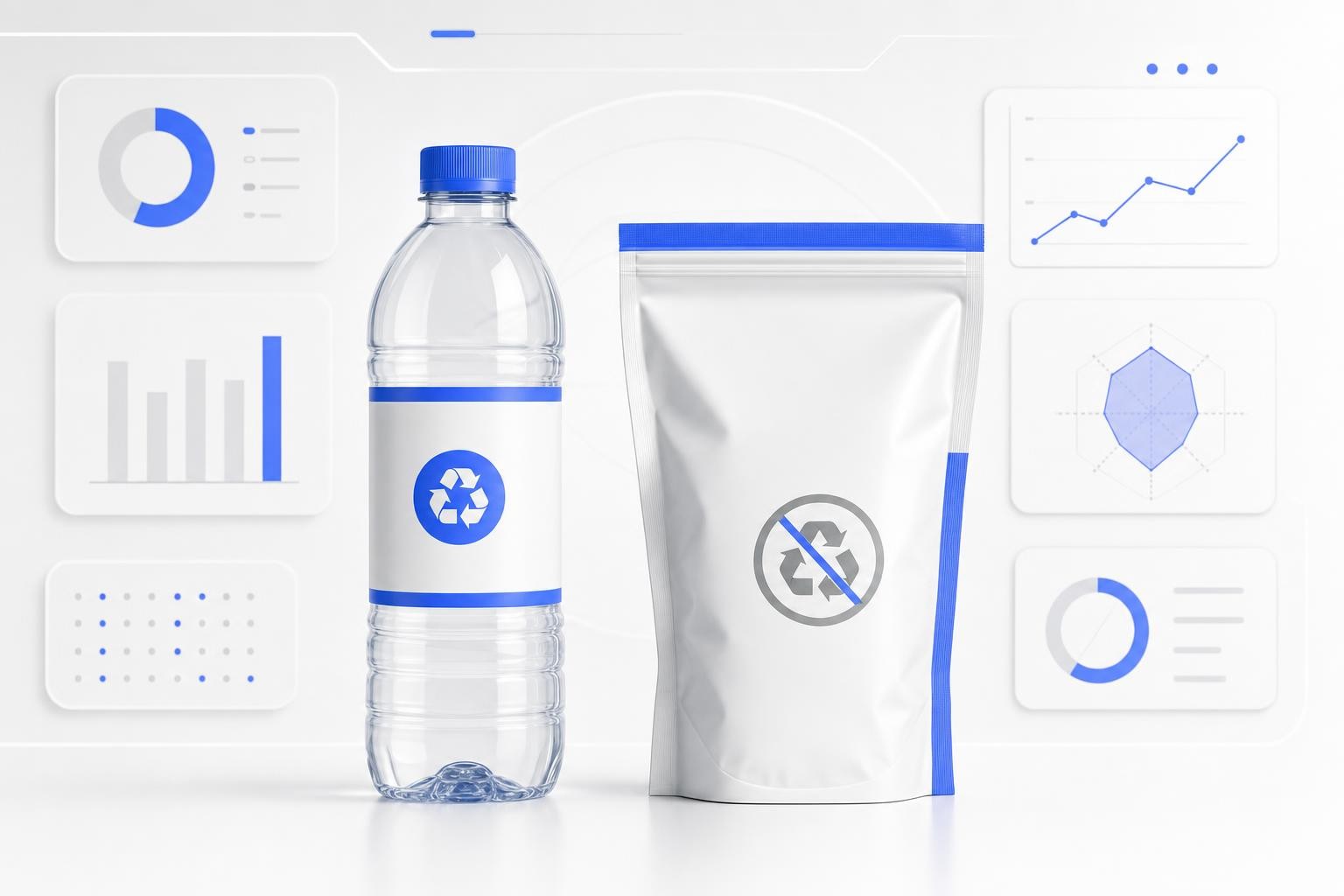
Two packages, both plastic, both destined for the same shelf. One will move through the EU market in 2030 without a hitch - the other won't. The difference has nothing to do with the product inside. It comes down to decisions made months earlier in the development process: Which color? Which label? Do we actually need an EVOH barrier?
From January 1, 2030, all packaging placed on the EU market must achieve at least Recycling Performance Grade C - meaning at least 70% of the packaging weight must be materially recyclable. Grades D and E will be banned outright. From 2038, Grade C will also be phased out - only Grades A and B will remain. Design for Recycling (DfR) is no longer an optional sustainability initiative; under PPWR Article 6, it is a prerequisite for market access.
This guide uses concrete material examples to show which design decisions drive the grade - and how to build a structured decision framework for your next packaging development project.
The Grading System: How Grades A Through C Are Determined
The PPWR divides recyclability into three performance tiers: Grade A (≥ 95%), Grade B (≥ 80%), and Grade C (≥ 70%). The precise assessment criteria will be established through delegated acts by the European Commission by January 1, 2028, covering 22 packaging categories. Until then, the ZSVR Minimum Standard and existing national assessment methodologies serve as the reference framework.
The 2025 ZSVR Minimum Standard underwent a fundamental structural overhaul and, for the first time, introduces a new calculation formula that allows companies to assess recyclability themselves based on concrete design parameters.
Four factors drive the assessment:
- Sorting compatibility - Can the packaging be reliably identified in existing sorting facilities and assigned to the correct material stream?
- Material separation - Can components (caps, labels, sealing films) be physically separated without degrading recyclate quality?
- Contaminant risk - Do colors, adhesives, coatings, or additives interfere with the recycling process?
- Infrastructure compatibility - Does an established, large-scale recycling process exist for the material?
Case Study 1: PET Bottle vs. Multilayer Pouch
This is the classic comparison - and it illustrates most clearly why material choice and layer structure are everything.
The Clear PET Bottle (Potential: Grade A)
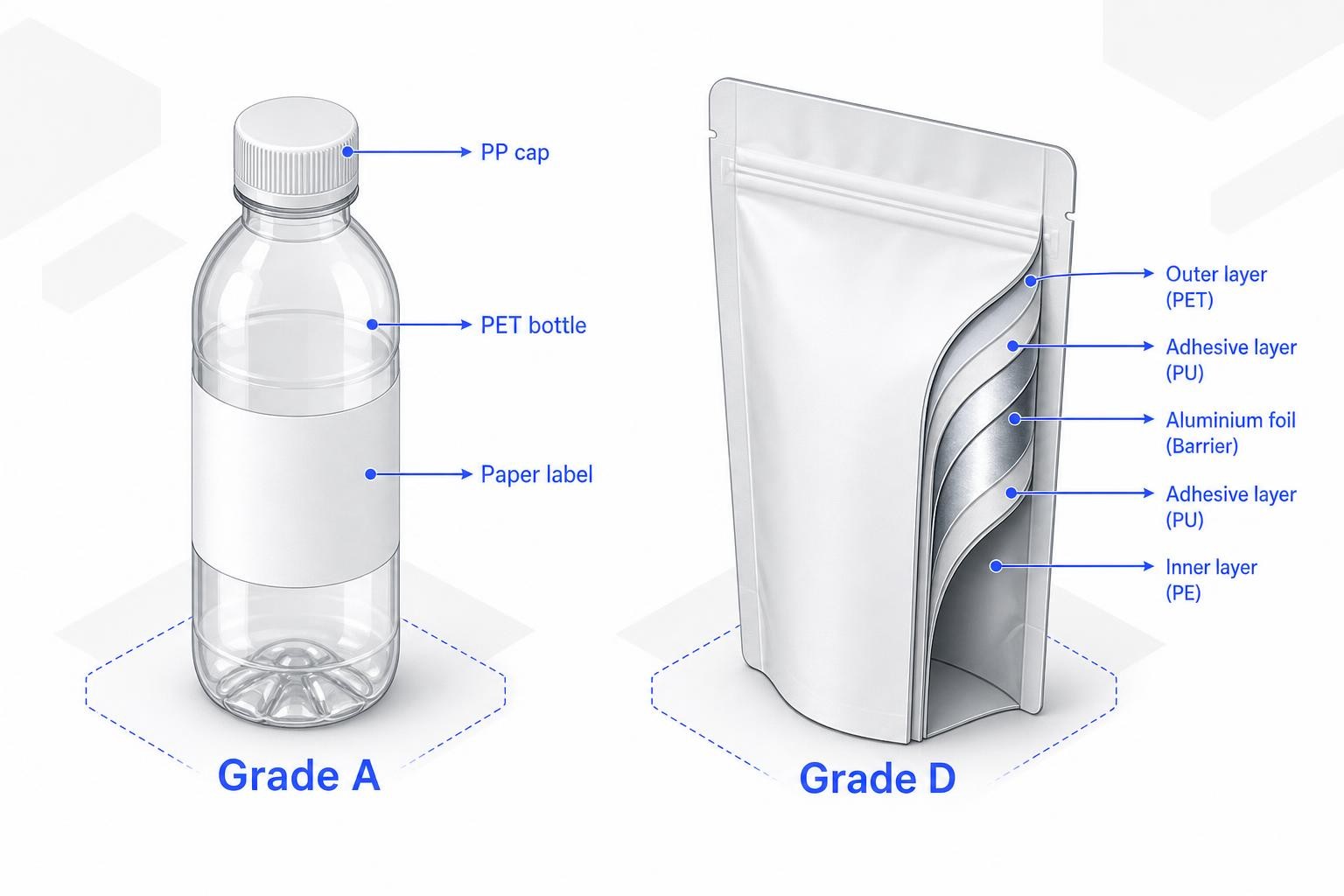
A clear PET bottle with no sleeve, a PP screw cap, and a paper-based label that releases during the wash process is the textbook example of recycling-compatible design. NIR sorting systems reliably identify PET. The PP cap is separated mechanically or through density differences in a water bath. The result is high-quality, source-pure PET recyclate.
What puts the grade at risk:
- Full-body shrink sleeves made of PET or PVC mask the bottle's NIR signature and can push the grade down to C or worse.
- Dark or metallized pigments (carbon black in particular) interfere with the recycling process and are explicitly listed as contaminants in the ZSVR Minimum Standard.
- Non-releasable adhesives leave residues that reduce recyclate quality.
The Multilayer Pouch with Aluminum Barrier (Risk: Grade D/E)
A typical stand-up pouch for food products consists of several bonded layers: a printed PET or OPP film on the outside, an aluminum barrier in the middle, and a PE sealing layer on the inside. These layers are bonded so tightly that mechanical separation is neither technically nor economically feasible.
NIR sorting systems produce mixed signals on these composite structures - the packaging is either misassigned or ejected as a contaminant. Flexible packaging with aluminum barrier layers bonded so tightly that separation is not economically viable is classified as Grade D under most assessment methodologies.
The way out: Mono-PE pouches, where all layers are made of polyethylene (optionally with a thin SiOx coating instead of aluminum foil), can be assigned to the PE recycling stream. Whether they reach Grade B or C then depends on printing inks, adhesives, and barrier thickness.
 AI-generated image
Case Study 2: Mono-PE Pouch vs. Composite Carton
For liquids and sauces, packaging teams frequently face a choice between flexible mono-material films and composite cartons.
Mono-PE Pouch (Potential: Grade B-C)
A pouch made entirely of polyethylene - all layers coextruded, no aluminum foil - can be assigned to the PE recycling stream. Recyclability then hinges on three design parameters:
- Printing inks: Opaque, dark inks can reduce recyclate quality. Light, transparent shades or direct printing with soluble inks are preferable.
- Adhesives: Soluble lamination adhesives allow cleaner layer separation during the recycling process.
- Barrier: Thin SiOx coatings (under 100 nm) are considered recycling-compatible; EVOH layers within mono-PE composites require more critical evaluation.
Composite Carton (Beverage Carton Type, Risk: Grade C-D)
Composite cartons typically consist of paperboard, polyethylene, and - in aseptic formats - an aluminum layer. Recycling infrastructure for beverage cartons exists in the US and Europe, but it is not as broadly established as the PET deposit system. Composite cartons are more complex to recycle than mono-materials, since separating fibers, plastic, and aluminum requires multiple process steps.
For manufacturers, this means: composite cartons can reach Grade C where the infrastructure exists - but demonstrating compliance is more demanding and the grade is more fragile.
The Four Design Levers at a Glance
| Designparameter | Fördert Grade A | Risiko Grade C oder schlechter |
|---|---|---|
| Farbe / Pigmente | Transparent, naturfarben, helle Töne | Rußschwarz, metallisierte Pigmente, dunkle Opakfarben |
| Etiketten & Sleeves | Kleines Papieretikett, ablösbar im Waschprozess | Vollflächiger Shrink-Sleeve, nicht ablösbarer Klebstoff |
| Barriereschichten | Keine Barriere oder dünne SiOx-Beschichtung | Aluminiumfolie, EVOH in Multilayer-Verbund, PFAS-Beschichtungen |
| Klebstoffe | Wasserlöslich oder lösemittelbasiert, ablösbar | Wasserresistente Klebstoffe, unlösbare Verbundklebstoffe |
| Materialstruktur | Monomaterial (PET, PE, PP, Glas, Papier) | Mehrschichtige Verbunde aus inkompatiblen Materialien |
| Verschlüsse & Zusatzteile | Gleiche Materialklasse wie Hauptkörper oder leicht trennbar | Materialfremde Verschlüsse, fest verklebte Dosierhilfen |
The Decision Framework for Your Next Packaging Development Project
Before you move into detailed development, answer these five questions - they cover the biggest DfR risks:
1. Which established recycling stream can the packaging be assigned to? If the answer is unclear, the risk is high. PET, HDPE, PP, glass, and paper have established streams. Composites made from incompatible materials do not.
2. Are there any elements that interfere with NIR sorting? Metallized surfaces, dark pigments, and full-body sleeves are the most common culprits. If so: is there a design alternative?
3. Are all barrier layers truly necessary? Barriers protect the product - but alternatives often exist. Secondary packaging, modified filling processes, or thinner coatings can meet functional requirements without destroying recyclability.
4. How do adhesives and printing inks behave in the recycling process? Not all adhesives are equal. Water-resistant adhesives on glass packaging can reduce the recoverable material fraction - this is explicitly addressed in the ZSVR Minimum Standard.
5. Is recyclability documented and audit-ready? From August 12, 2026, producers must issue an EU Declaration of Conformity for each packaging item and maintain technical documentation that must be made available within 10 days upon request. If you can't demonstrate recyclability, you have a compliance problem - regardless of how well-designed the packaging actually is.
Why Design Decisions Today Determine EPR Costs Tomorrow
DfR is not just a compliance question - it's a cost question. EPR fees will increasingly be tiered according to a packaging's environmental performance (eco-modulation): packaging with higher recyclability pays lower fees, while hard-to-recycle packaging pays more. France, Italy, and Belgium are already implementing detailed eco-modulation rules.
That means: a design decision made today in the development process - shrink sleeve or paper label, aluminum barrier or SiOx coating - directly affects the EPR fees a company pays in every EU country where it places that packaging on the market.
The most common pitfall: Many companies optimize the primary material (e.g. switching to mono-PE) but overlook the fact that adhesives, printing inks, and labels affect the recyclability of the entire packaging unit. The assessment always applies to the complete packaging including all integrated components — not just the main body.
From Design Decision to Audit-Ready Documentation
The most common bottleneck in practice isn't a lack of design knowledge - it's a lack of data availability. Material compositions, layer structures, adhesive specifications, and barrier thicknesses are scattered across PDF spec sheets, emails, and ERP systems. Without a structured data foundation, any recyclability assessment is little more than guesswork.
Packa digitizes technical specifications in under 2.5 minutes per packaging type - making the recyclability grade for every SKU in your portfolio visible, traceable, and audit-ready. A design decision becomes a documented compliance record.
Speak with a Packa expert about how to assess, document, and systematically improve the recyclability of your packaging portfolio — free of charge and without obligation.
Talk to a Packaging ExpertWhen does the recyclability requirement under PPWR take effect?
From January 1, 2030, all packaging placed on the EU market must achieve at least Grade C (≥ 70% recyclable). From 2038, Grade C will no longer be sufficient — only Grade A and B will be permitted. The obligation to provide a declaration of conformity already applies from August 12, 2026.
When will the specific Design for Recycling criteria under PPWR be published?
The European Commission must publish the delegated acts containing the concrete DfR criteria for 22 packaging categories by January 1, 2028 at the latest. Until then, national standards such as the ZSVR minimum standard serve as a reference framework.
Is a mono-PE pouch automatically recyclable?
Not automatically. Monomaterials made from PE or PP can generally be assigned to the corresponding recycling stream — but actual recyclability depends heavily on additives such as adhesives, printing inks, and barrier layers. A mono-PE pouch with opaque printing inks and a water-resistant adhesive can still perform poorly.
How does the recyclability grade affect EPR fees?
Through ecomodulation, EPR fees will increasingly be linked to the recyclability of packaging. Packaging with higher recyclability pays lower fees. Countries such as France, Italy, and Belgium are already implementing differentiated ecomodulation rules. This means that every improvement in recyclability grade has a direct financial impact.
What must be included in the technical documentation for recyclability?
The technical documentation must systematically list material composition, layer structure, barriers, adhesives, labels, and all integrated components. The ZSVR has published template documents. Upon request from the competent authority, the documentation must be able to be submitted within 10 days.