
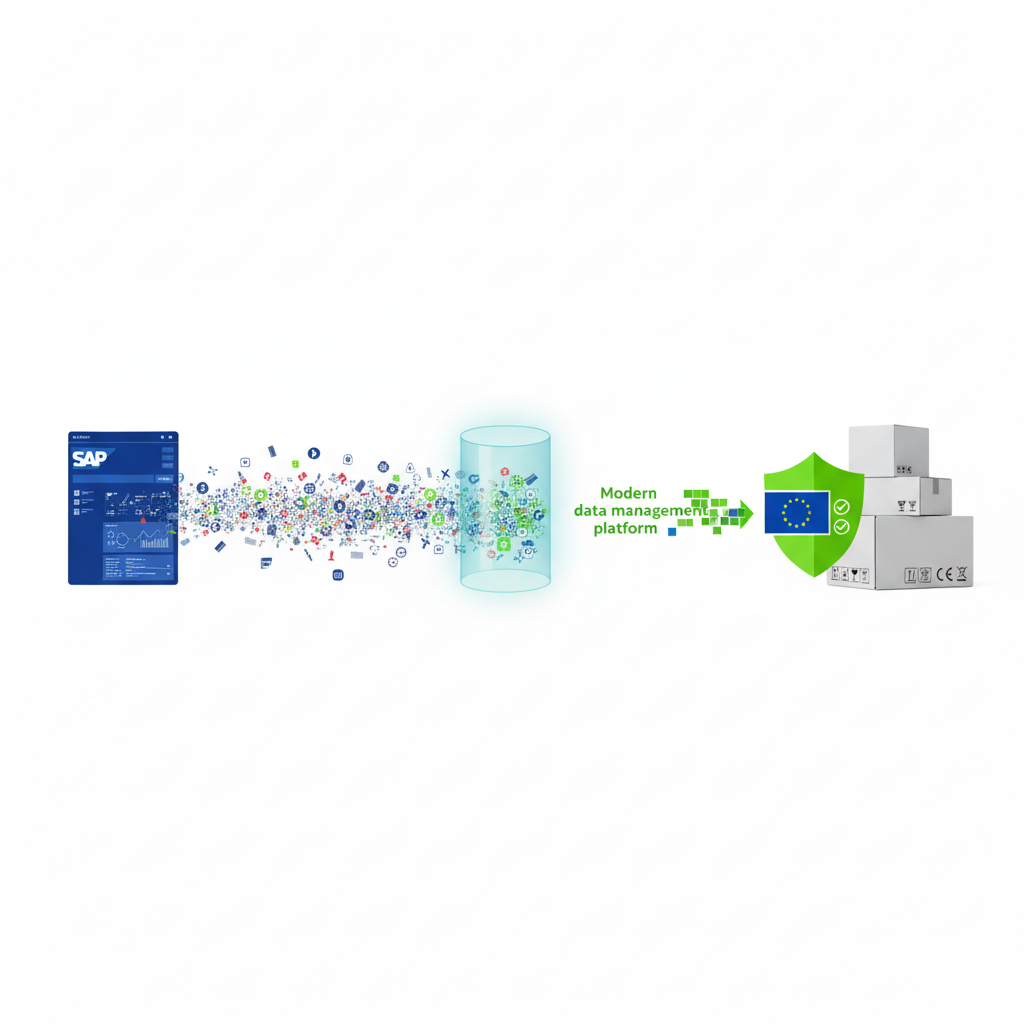
Since 11 February 2025, the PPWR (Packaging and Packaging Waste Regulation) has been transforming packaging management across Europe. After the 18-month transition period, companies must provide comprehensive packaging data digitally from 12 August 2026, implement digital labelling from 2027, use harmonised EU-wide labels with standardised pictograms from August 2028, and demonstrate full recyclability by 2030. For SAP users, this means one thing: your existing ERP systems must be seamlessly integrated with central packaging data management platforms.
This technical guide explains how to successfully integrate Packa's Central Packaging Data Management into your SAP landscape - from the initial data assessment to full production rollout.
Why central packaging data integration is becoming business-critical now
The regulatory requirements are clearly defined: The PPWR has been in force since 11 February 2025 and, after a precisely defined 18-month transition period, will be fully applicable from 12 August 2026. From this date, companies must maintain declarations of conformity and technical documentation for every packaging type.
The next escalation level follows in 2027: packaging must carry digital labels such as QR codes that link to structured environmental information. Another level is reached from August 2028: all packaging must bear harmonised EU-wide labels with standardised pictograms clearly identifying material composition. By 2030 at the latest, all packaging must be 100% recyclable and meet specific recycled content targets.
The cost implications are significant: Companies that do not systematically digitise their packaging data risk:
- Regulatory fines for non-compliance from August 2026
- Higher EPR fees due to incomplete recyclability evidence
- Manual effort to create digital product passports from 2027
- Competitive disadvantages due to inefficient packaging portfolio optimisation
"Integrating packaging data into existing ERP systems is no longer a technical nice-to-have, but a business-critical necessity," as confirmed by the current legal framework for implementing the PPWR.
Integration architecture: From data silos to a central packaging management platform
Current vs. target architecture
Typical situation in most SAP environments:
- Packaging data scattered across MM (Material Master), SD (Sales & Distribution), and separate Excel files and/or PDF files in a SharePoint
- Manual maintenance of specifications with no central validation (if any technical packaging data exists at all)
- Certificate management in isolated file systems
- No automated compliance checks
Target architecture with an integrated packaging data platform:
- Centralised packaging database as the single source of truth
- Bidirectional API integration between SAP and the packaging management system
- Automated compliance workflows with real-time validation
- Integrated certificate tracking with expiry alerts
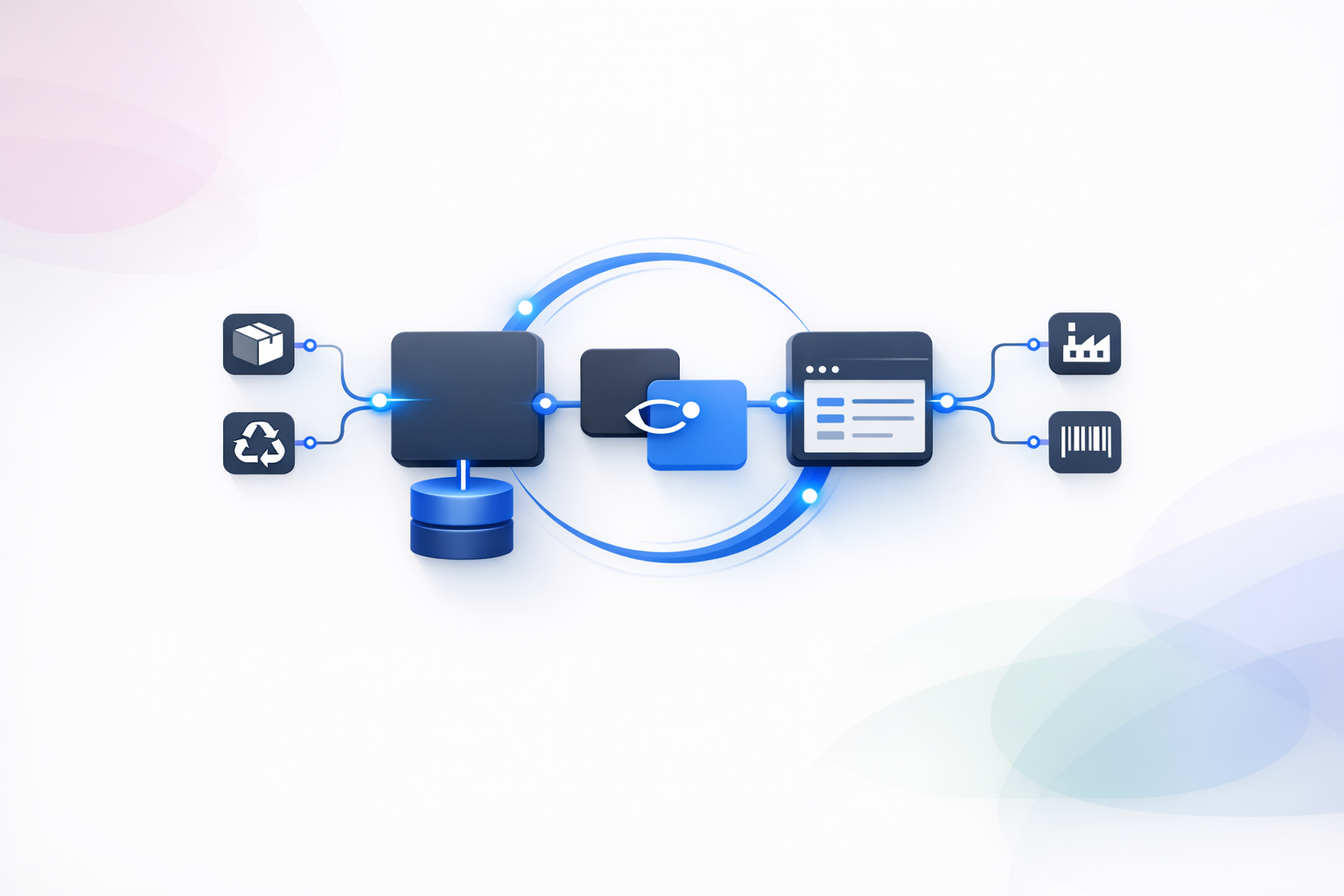
Data flow overview between SAP ERP and Packa
The technical data flow runs through four main phases:
- Data extraction from SAP: Material master data is exported from SAP MM/SD
- Data transformation: The Packa system enriches missing packaging specifications using AI-based analysis
- Data enrichment: Automated compliance assessment and recyclability calculation
- Resynchronisation: Completed data records are transferred back into the SAP system
API-based vs. batch integration comparison
| Criterion | API-based (Recommended) | Batch integration |
|---|---|---|
| Data freshness | Real-time updates | Daily/weekly |
| Implementation time | Typically 2-3 weeks* | Typically 1-2 weeks* |
| System load | Low, event-driven | High at batch times |
| Error handling | Immediate notification | Delayed detection |
| PPWR compliance | Optimal real-time monitoring | Risk of outdated data |
*Timeframes are based on experience from comparable SAP integration projects and may vary depending on system complexity.
Technical implementation: Step-by-step integration into SAP environments
Phase 1: Data inventory and mapping
Step 1: Inventory of existing packaging data
Start with a full analysis of your SAP MM/SD data:
- Extract all material-related master data that is relevant for packaging
- Document existing customising settings for packaging fields
- Identify data quality gaps in critical PPWR fields
- Record external data sources (Excel lists, supplier documentation)
Step 2: Perform data quality analysis
Experience shows that companies often discover that key packaging specifications are incomplete. Typical gaps include material compositions, recycling codes, and certificate information.
Step 3: Field mapping between SAP and Packa
Critical mappings for PPWR compliance:
| SAP field | Table | Packa data field | PPWR relevance |
|---|---|---|---|
| MATNR | MARA | Material_ID | Unique identification |
| MTART | MARA | Material_Type | Packaging classification |
| LABOR | MARM | Base_Unit | Quantity information |
| Custom Z fields | MARA | Material_Composition | Recyclability |
Phase 2: API integration and data synchronisation
RESTful API configuration
The technical integration is implemented via standardised REST APIs:
Endpoint: https://api.packa.eu/v1/sap-integration
Authentication: OAuth 2.0 with Client Credentials
Data format: JSON with SAP-compliant field structures
Rate limits: 1000 requests/minute for real-time sync
Decision matrix for real-time vs. batch synchronisation
Choose real-time integration if:
- You have more than 1,000 material changes per month
- PPWR compliance is time-critical (for product launches)
- Multiple teams work on packaging data in parallel
Choose batch integration if:
- You have a stable packaging portfolio with low change frequency
- Overnight processing windows are available
- You prefer lower system complexity
Error handling and retry mechanisms
Implement robust error handling:
- Automatic retries for temporary network errors (3x retry with exponential backoff)
- Detailed logging of all API calls for debugging
- Fallback to local data storage during longer outages
- Notifications to system administrators in case of critical errors
Phase 3: User access management and workflows
SAP user integration via Single Sign-On
Leverage your existing SAP user structures:
- SAML 2.0 integration for seamless sign-on
- Adoption of SAP roles and authorisations
- Automatic provisioning of new users
- Central user management via SAP Identity Management
Role-based access control
Define clear authorisation structures:
| SAP role | Packa permission | Scope of functions |
|---|---|---|
| Packaging Manager | Admin | Full access to all functions |
| Procurement Buyer | Editor | Supplier data and cost analysis |
| QA Manager | Reviewer | Compliance checks and certificates |
| Material Planner | Viewer | Read-only access to specifications |
Compliance automation: Achieving PPWR conformity through intelligent data processing
Automated recyclability calculation
The integrated system continuously assesses the recyclability of your packaging against the latest Circular Packaging Design Guidelines:
- Real-time analysis of material compositions
- Automated assessment of separability and sortability