

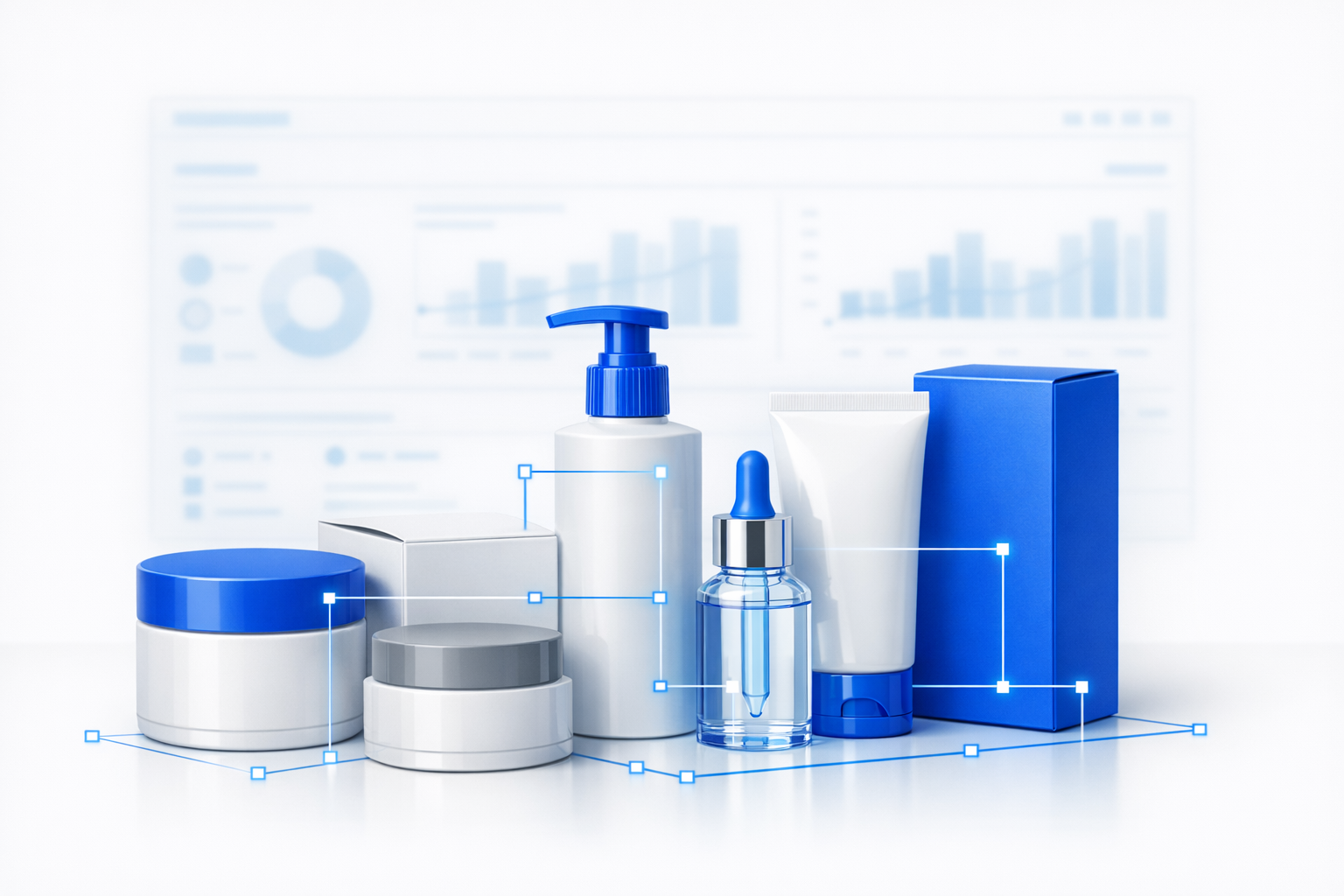
An average cosmetic product - jar, cap, pump, applicator, folding box - easily comes with up to five separate packaging components. From 12 August 2026, each of these will need a valid PPWR Declaration of Conformity (DoC). If you have 200 SKUs in your portfolio, you are quickly looking at 600 to 1,000 individual DoC items - and that is before the first limited edition of the year goes live.
For packaging owners in the cosmetics and personal care industry, PPWR is not an abstract regulatory topic. It is an operational challenge that cuts directly across product planning, supplier management, and artwork processes. This guide shows what is specifically different for your industry - and how to approach it in a structured way.
Why cosmetics are more complex than the rest
The PPWR applies to all packaging placed on the EU market. But not all industries are affected in the same way. In cosmetics and personal care, four factors come together in a combination that is unique:
1. Multi-component packaging While a yogurt cup consists of a single primary packaging, a typical cosmetic product is made up of 3-5 components: jar or bottle (plastic, glass, or aluminium), cap (often a different material), pump or dispenser (metal + plastic + seals), decorative inlay or applicator, folding box made of cardboard. Each of these components has its own material composition, its own recyclability assessment and - depending on the supplier - its own DoC requirements. For brands that rely heavily on sustainable cosmetic packaging and complex multi material packaging, this quickly becomes a major compliance burden.
2. High regulatory overlap Packaging owners in cosmetics do not only work under PPWR. The EU Cosmetics Regulation 1223/2009 already sets requirements for product contact, EUDR introduces requirements for certain raw materials in the supply chain, and CSRD mandates documented sustainability reporting. These frameworks overlap in terms of the data they require - and significantly increase documentation requirements.
3. Brand-critical artwork processes Cosmetic brands redesign more frequently than almost any other industry: seasonal collections, limited editions, co-branding, rebranding. Every packaging change that introduces new materials, coatings, varnishes, or suppliers triggers a new compliance check under PPWR. If you do not have a structured compliance gate in your artwork process, you risk placing products on the market with outdated or invalid Declarations of Conformity.
4. EPR complexity through multi-material Under PPWR, EPR fees will be eco-modulated - packaging with higher recyclability pays less. For a cosmetic product with plastic jar, metal pump, and paper folding box, this means: three to five separate material fractions that must be captured, assessed, and reported separately - for each EU country where you sell the product.
Starting from 12 August 2026 all packaging placed on the EU market must have a valid PPWR conformity declaration (Declaration of Conformity, DoC). For cosmetics packaging portfolios with 3-5 components per product, that means: every component, every change, every new product line triggers its own compliance review. Those who are still working with Excel and PDFs today will not meet the deadline.
The multi-component trap: DoC obligation for every packaging unit
From 12 August 2026, producers must have a Declaration of Conformity for every packaging they place on the EU market and present it to authorities upon request. The DoC confirms compliance with Articles 5 to 12, 24, and 26 of PPWR - in particular substance restrictions, recyclability, minimisation requirements, and labelling.
For cosmetic companies this means in practice:
- Requesting supplier DoCs: If you source pumps, caps, or applicators from external manufacturers, you must obtain documented PPWR compliance from them. A supplier delay a few weeks before the deadline is not a minor issue - it is a market exclusion problem.
- Creating your own overall DoC: If you, as the producer, carry overall responsibility for the packaging, you must consolidate all component-level evidence into a structured overall documentation.
- Ensuring versioning: Every material change, every supplier switch, every formulation adjustment of a coating invalidates the existing DoC. Without version control, you lose audit security.
Packa generates PPWR Declarations of Conformity directly from digitized specification data - for individual components as well as for complete products. Scattered packaging data turns into a usable data basis from which DoCs are generated in minutes instead of weeks.
| Criterion | Cosmetics & Personal Care | Standard FMCG | Risk Level |
|---|---|---|---|
| Packaging components per SKU | 3-5 (jar, lid, pump, applicator, outer carton) | 1-2 | 🔴 High |
| DoCs per SKU required | Up to 5 separate DoCs | 1-2 | 🔴 High |
| PFAS Risk | Medium-High (Coatings, Barrier layers, Paints) | Medium (Food contact) | 🟡 Medium-High |
| Regulatory Overlap | PPWR + EU Cosmetics Regulation 1223/2009 + EUDR + CSRD | PPWR + LMIV + EUDR | 🔴 High |
| Artwork redesign frequency | High (seasonal, Limited Editions, Relaunches) | Medium | 🔴 High |
| EPR reporting complexity | 3-5 material fractions per product | 1-2 Material fractions | 🔴 High |
PFAS in cosmetic packaging: underestimated risk, clear need for action
From 12 August 2026, strict PFAS limits will apply under PPWR for food-contact packaging: a maximum of 25 ppb per individual substance and 250 ppb in total. Sounds like a topic only for food and beverage? For cosmetics teams it is not - for three reasons:
Where PFAS can appear in cosmetic packaging
PFAS-containing substances are used in the packaging industry as coatings, barrier layers, varnishes, and adhesives. In cosmetic packaging, they can occur in:
- Gloss varnishes and surface finishes on cardboard outer packaging
- Barrier layers in laminates for flexible packaging (e.g. wipes, masks)
- Sealing components in pumps and dispensers
- Anti-fingerprint coatings on metal components (lipstick cases, perfume bottles)
These uses can undermine your efforts to move towards pfas free packaging and more sustainable cosmetic packaging if they are not visible in your data.
Why this still matters for cosmetics
Even though the PPWR PFAS limit directly targets food-contact materials: for products with food or mucosal contact - lip care, toothpaste, mouth spray - these limits apply directly. Beyond that, growing enforcement practice under REACH and CSRD is creating de facto pressure for PFAS transparency even in non-food packaging.
What you should do now:
- Flag all packaging components with coatings, varnishes, or laminates as PFAS risk components
- Request written PFAS-free statements and test reports from suppliers
- For products with food or mucosal contact: commission laboratory analysis, do not rely solely on supplier declarations
- Store results centrally with proper versioning
You can find our detailed analysis of PFAS evidence obligations and supplier communication in our article on the PFAS ban 2026[1].
Artwork redesigns as compliance triggers: the invisible risk factor
For cosmetic brands like Pomélo + Co / Shyne or Paper & Tea, packaging is not an afterthought - it is a core brand message. Seasonal editions, co-branding projects, and relaunch cycles are part of day-to-day business.
The problem: every artwork process that introduces new materials, varnishes, finishes, or suppliers is also a PPWR compliance event. In practice, it looks like this:
| Artwork change | PPWR relevance |
|---|---|
| New ink set with different pigments | Check recyclability assessment |
| Switch from gloss to matt varnish | Potentially requires new coating analysis |
| New cardboard supplier | New supplier DoC required |
| New foil finishing (hot foil stamping) | Check material and recyclability relevance |
| Changed label with different adhesive | Adhesive may affect recyclability rating |
The structural mistake many cosmetics teams make today: artwork approval and compliance review run in separate workflows. The design agency delivers the final print file, and only weeks later someone realises that a new foil has downgraded recyclability from class B to C.
The solution: an integrated compliance gate in the artwork approval process - automatically triggered by any material change, centrally documented, and audit-proof. Packa's Artwork & Approval Workflow links print approvals directly to the specification and compliance status of the respective packaging.
EPR for multi-material packaging: why cosmetics are particularly demanding
Extended Producer Responsibility (EPR) is not a new topic. But PPWR tightens the requirements significantly - and eco-modulated fees make structured packaging data an economic necessity.
For cosmetics, this means in concrete terms: a product with plastic jar (PP), metal pump (aluminium + steel), plastic cap (ABS), paper leaflet, and folding box outer packaging generates five different EPR-reportable material fractions. For every country in which you sell the product, reported separately.
Two common mistakes in the cosmetics industry:
- Weights are estimated instead of measured. Incorrect EPR reports lead to back payments, fines, and in the worst case a LUCID suspension.
- Component data sits with the supplier, not with the producer. If you do not have your own structured data basis, you cannot respond properly when authorities request information.
You can find more detail on specific EPR obligations and cost drivers in our guide to EPR fees in Europe[2].
How complex is your portfolio? Calculate now
Use our interactive compliance calculator to estimate how many DoCs you will need, how much manual effort will be required without digital support - and where your portfolio sits on the complexity scale for cosmetic packaging.
7 steps to PPWR compliance: the checklist for cosmetics packaging teams
Capture every packaging component in your portfolio - jars, caps, pumps, applicators, inlays, outer cartons, and carrier bags. Document material, weight, supplier, and function per component. Without this data foundation, a valid DoC is not possible.
Identify all packaging components with coatings, barrier layers, varnishes, or adhesives. Request from suppliers written PFAS-free declarations. For food-contact components (e.g., lip care products): PFAS laboratory analysis in accordance with PPWR Article 5 is mandatory.
Evaluate the recyclability of each component according to EU criteria (Design for Recycling). Multi-material laminates, metal pumps in plastic jars, or coated cartons can reduce the recycling class of the overall product—and increase your EPR fees.
Create a separate DoC for each packaging component or request them from your suppliers. Store all evidence centrally, versioned, and auditable. Ensure that every artwork change automatically triggers a DoC review.
Capture material fractions and weights per component in machine-readable form. A cosmetics product can generate 3-5 different EPR-mandatory fractions. Without structured component data, correct EPR reporting in several countries is not possible.
Implement a binding compliance check in your artwork approval process. Every packaging change — including color changes, new text, and new suppliers — must trigger an automatic check to determine whether the DoCs, recyclability assessments, and EPR data are still up to date.
Consolidate all component data, DoCs, supplier declarations, PFAS evidence, and recyclability assessments on a single digital platform. Only then can you pass PPWR audits, automate EPR reporting, and manage new product launches in a compliant manner.
How Packa supports cosmetics teams in practice
Packa was developed from 850+ real packaging projects with 300+ enterprise customers and 350+ manufacturers - including cosmetic brands like Pomélo + Co / Shyne and Mister Spex. The platform directly addresses the specific challenges of the industry:
- AI-powered spec digitization: Technical data sheets for jars, pumps, and folding boxes are converted into structured, machine-readable data in under 2.5 minutes - whether they come as PDF, Excel, or ERP export.
- Component-based DoC generation: For every packaging component, Packa generates its own DoC or stores and versions the supplier's DoC.
- Integrated artwork compliance trigger: Every change in the artwork approval process automatically triggers a compliance review.
- Multi-material EPR calculation: Weights and material fractions per component flow directly into the EPR calculation logic - for all sales countries.
- PFAS tracking and supplier data management: PFAS evidence, PFAS-free declarations, and test results are managed centrally and are immediately available during audits.
The result: Save up to 40% on packaging purchasing, 70% faster tenders, and a 100% digitised specification data portfolio. Save time, gain control - and move towards compliant, pfas free packaging and truly sustainable cosmetic packaging across your entire cosmetic packaging range.
PPWR software for packaging management
Check your PPWR readinessFAQ: PPWR 2026 for Cosmetics & Personal Care
Does the PPWR also apply to cosmetic packaging that does not come into contact with food?
Yes. The PPWR applies to all packaging placed on the market in the EU - regardless of the packaged product. Recyclability requirements, declarations of conformity, labeling obligations and EPR reporting duties apply to cosmetic packaging just as to food packaging. Only the strict PFAS limits (Art. 5 PPWR) apply directly only to food contact materials - however the minimization principle and growing market expectations argue for proactively collecting PFAS also in other packaging categories.
Do I need a separate DoC for every jar, lid and pump?
In principle yes. The DoC refers to packaging types, not to individual SKUs. For multi-component packaging, all components that are marketed independently must be covered. In practice, that means: either you obtain DoCs from your suppliers for each component, or you create as the manufacturer a total DoC that aggregates all components and their conformity evidence.
What happens if I launch a new Limited Edition with different artwork?
If the material composition or the supplier changes due to the new artwork, a new DoC is required. Even if only the printing image changes and thus, for example, new printing inks or coatings are used, this can affect the recyclability assessment. Therefore, a clean artwork approval process with an integrated compliance gate is essential.
How complex is the EPR reporting for a cosmetic product with multiple components?
Much more complex than simple disposable packaging. A typical cosmetic product (jar with plastic body, metal pump, plastic cap, paper insert, carton outer packaging) generates 3-5 different material fractions that must be reported separately. In addition: EPR fees are eco-modulated - packaging with better recyclability pays less. Whoever has structured their component data can optimize accordingly.
When should I start PPWR preparation?
Now. Supplier DoCs must be requested, material analyses conducted, and data structures built. Everything placed on the market after August 12, 2026 must be fully compliant - with no grandfathering for ongoing productions.
Conclusion: PPWR is not a standard compliance project for cosmetics
The cosmetics and personal care industry faces a PPWR challenge that is qualitatively different from other sectors: multi-component structures, high artwork frequency, overlapping regulations, and complex EPR multi-material reporting combine into a compliance burden that can no longer be managed with Excel sheets and email requests.
From 12 August 2026, all packaging newly placed on the EU market must be fully PPWR compliant - with no grandfathering for ongoing production. The countdown is on.
Teams that start building a structured, digital data basis now will not only meet the deadline - they will also lay the foundation for faster launches, lower EPR fees, and robust CSRD reporting. Pack the future.
You can find a complete overview of the most common mistakes in PPWR preparation in our article The 10 most common mistakes in PPWR preparation[3].