

The EU Packaging and Packaging Waste Regulation (PPWR) will apply directly and in full from 12 August 2026. It tightens documentation requirements, raises the bar for recyclability and labelling, and introduces fines of up to €200,000 per infringement.
For packaging, this is no longer "business as usual". You will need complete, audit-ready data across thousands of packaging items, including:
- Detailed packaging specifications and material structures
- Evidence of recyclability and recycled content
- Declarations of conformity and technical documentation
- Supplier certificates, test reports and audit documents
- Labelling proofs (including future QR codes / digital product passports)
Many companies still try to manage all of this in Excel. For simple day-to-day lists, that's fine. For PPWR compliance at scale, it isn't. This article compares Excel with a specialised digital packaging platform - and explains why spreadsheets inevitably lead to document chaos, compliance gaps and rising risk.
What PPWR really means for your data and documentation
Under the PPWR, packaging data moves from "nice to have" to a "license to operate":
- Directly applicable EU law: Unlike previous directives, the PPWR applies without national transposition. Requirements are uniform - and enforced - across the EU.
- Short transition period: Companies have only around 18 months to adapt their designs, supply chains and documentation.
- Proof, not promises: Authorities and customers will expect verifiable documentation for recyclability, material composition, extended producer responsibility (EPR) fees and claims such as "recyclable" or "climate-neutral".
For organisations with more than 1,000 packaging items, multiple plants and international suppliers, this creates three core challenges:
- Volume - tens of thousands of data points and documents
- Complexity - changing legal rules, markets and materials
- Traceability - being able to demonstrate, at any time, where data comes from and whether it is up to date
This is exactly where Excel reaches its limits.
How most companies still manage PPWR in Excel today
Typical PPWR "setups" we see in FMCG, food & beverage, cosmetics and e-commerce:
- Multiple Excel files by brand, plant or country
- Local versions on network drives or in personal folders
- Email as the main "workflow engine" for supplier queries and approvals
- Certificates and test reports as scattered PDFs with no expiry tracking
- Manual copy & paste between ERP exports, lab reports and master spreadsheets
This might just about work for a few dozen SKUs. But once you reach 500, 1,000 or 5,000+ packaging items, the model breaks down.
Seven concrete reasons why Excel fails you under PPWR
1. Document chaos instead of a single source of truth
In our webinars with packaging and sustainability leaders, the same risks come up again and again: missing evidence, document chaos and compliance gaps.
With Excel:
- There are multiple versions of the "master file" across different teams
- Certificates are stored separately with no clear link to the item
- Nobody can see at a glance which documents are missing or expired
Result: When an auditor or key customer asks for proof, finding the correct, up-to-date documents becomes a project in itself.
A specialised platform like Packa centralises all packaging specifications, documents and supplier data in a single audit-ready system - including versioning, expiry dates and responsibilities.
2. Hidden data gaps and error risk
Manual Excel maintenance inevitably leads to:
- Inconsistent material names and layer structures
- Missing data for recyclability assessments
- Typing errors in weights, dimensions or material codes
Real-world digitisation projects show that 30-70% of required packaging data is typically missing or incomplete when first consolidated.
A digital packaging platform automatically:
- Identifies data gaps
- Enforces mandatory fields
- Uses AI-supported extraction to populate specifications from PDFs and technical data sheets
3. No embedded PPWR logic or automated checks
Excel is a blank grid. To use it for compliance, you have to:
- Interpret legal texts and guidance on your own
- Translate them into formulas, conditional formatting and macros
- Continuously update rules as PPWR details and national interpretations evolve
This is error-prone and not scalable.
A specialised packaging compliance engine instead:
- Stores regulatory logic centrally (PPWR, EUDR, ESG, digital product passport)
- Automatically checks your packaging portfolio against current rules
- Flags non-compliant items and required redesigns in real time
You don't build and maintain the legal logic yourself; you consume it as a service.
4. No real audit trail
PPWR will not only ask what your data is, but also how you manage it. With Excel, you generally cannot:
- See who changed which value and when
- Reconstruct earlier versions of a specification
- Prove that only authorised users edited compliance-critical fields
Modern packaging software offers comprehensive versioning and audit trails, so you can demonstrate data governance and accountability at any time.
5. Inefficient supplier collaboration
PPWR compliance is impossible without your converters, printers and material suppliers. In Excel-based setups, collaboration typically looks like this:
- Long email threads and attachments
- Manual reminders when certificates expire
- Repeatedly requesting the same data points
A platform like Packa automates supplier communication:
- Structured data requests instead of unstructured emails
- Clear deadlines and automated reminders
- Direct upload of certificates into the correct item record
You move from reactive chasing to proactive, standardised workflows.
6. No scalability for thousands of items
Excel was never designed to be a multi-user, multi-country compliance backbone. Problems grow exponentially with:
- 10+ stakeholders across procurement, packaging, quality and ESG
- Thousands of SKUs and complex packaging hierarchies
- Multiple legal regimes and customer-specific requirements
Digital packaging management platforms are built for exactly this use case: they handle complex hierarchies, user roles and large data volumes without collapsing back into manual firefighting.
7. Cost and opportunity losses
Beyond risk, Excel carries a very real cost:
- High manual effort for data maintenance, report creation and audits
- Slow tenders because specifications are incomplete or inconsistent
- Missed savings due to poor transparency on materials, prices and suppliers
Customers using Packa report 15-40% savings potential in packaging procurement and up to 70% faster tenders, because all specifications and documents are centrally available and comparable.
In other words: sticking to spreadsheets is not only risky - it is expensive.
What a specialised packaging compliance platform does differently
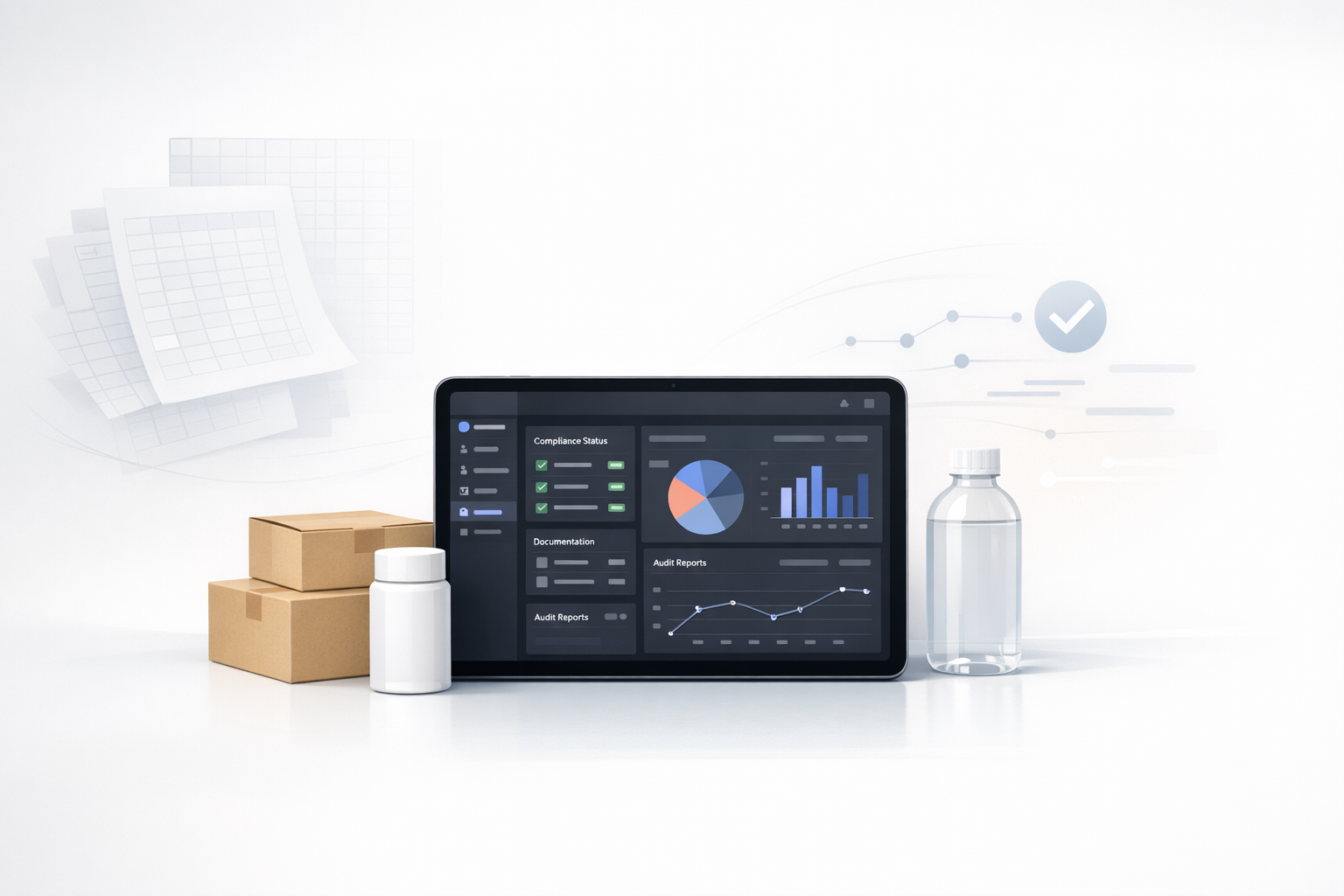
A digital packaging management platform like Packa is designed from the ground up for PPWR, EUDR and ESG requirements. Core capabilities include:
- Centralised data model: One consistent data structure for all packaging items, components, materials and suppliers
- End-to-end digitisation: From Excel and ERP imports to AI-based specification extraction from PDFs, with expert validation
- Automated compliance checks: PPWR, recyclability, labelling and other rules are embedded in the platform
- Document and certificate management: Expiry tracking, reminders and direct linkage to items and suppliers
- Analytics and reporting: Portfolio-wide views on recyclability, CO₂, EPR fees and cost-saving opportunities
- Audit-ready documentation: Version histories, approvals and evidence at the click of a button
In short: once your packaging is digitised in a central system, you can control and improve it continuously - instead of constantly reacting to exceptions in Excel.
Excel vs. digital packaging platform - a direct comparison
| Area | Excel Spreadsheet | Digital Packaging Platform (e.g. Packa) |
|---|---|---|
| Data model | Free-form, inconsistent columns and naming | Standardised packaging data model with validation rules |
| Compliance logic (PPWR, etc.) | Manual formulas, fragile macros | Embedded, centrally maintained compliance engine |
| Documents & certificates | Scattered PDFs, manual tracking | Linked to items, expiry tracking, automated reminders |
| Supplier collaboration | Email and attachments | Structured workflows, portals and automated requests |
| Audit readiness | Little or no audit trail | Full version history and role-based approvals |
| Scalability | Quickly becomes slow and error-prone | Built for thousands of items and multi-team collaboration |
| Time & cost impact | High manual effort, hard to see savings | Proven savings potential and efficiency gains through automation |
Key benefits: packaging software vs. Excel
When decision-makers search for "benefits of packaging software", they are usually looking for concrete, measurable advantages over tools like Excel. In the PPWR context, these benefits fall into three main areas:
Compliance and risk
- Lower probability of fines and being barred from markets
- Fewer surprises in audits and customer assessments
- Better control over claims, recyclability and documentation scope
Efficiency and cost
- Less manual data entry and chasing of documents
- Faster tenders and harmonisation of packaging portfolios
- Data-driven negotiations through transparency on prices and specifications