

If your company places any packaging on the EU market - regardless of material, sector, or where you're headquartered - Regulation (EU) 2025/40 is now your legal baseline. The PPWR (Packaging and Packaging Waste Regulation) is not a directive that member states can interpret differently. It is a directly applicable EU regulation, and its general application date is 12 August 2026.
This page is the reference overview. It explains what the PPWR is, who it applies to, what each core obligation block requires, and how the requirements phase in through 2040. Deeper dives on specific topics - recyclability grading, recycled content targets, labelling, and the Declaration of Conformity - are linked throughout.
What Is the PPWR - and What Did It Replace?
The PPWR, Regulation (EU) 2025/40, was published in the EU Official Journal on 22 January 2025 and entered into force on 11 February 2025. It applies generally from 12 August 2026, with a phased schedule of additional requirements running through 2040.
The regulation replaces the Packaging and Packaging Waste Directive 94/62/EC (PPWD), which had governed EU packaging law for over 25 years. The shift from a directive to a regulation is deliberate and consequential. Directives set goals but leave implementation to member states - which produced significant inconsistencies across the EU in areas like EPR fees and environmental labelling. A regulation applies uniformly in all 27 member states without national transposition. There is no waiting for a German or French implementation law: the obligations land on businesses directly.
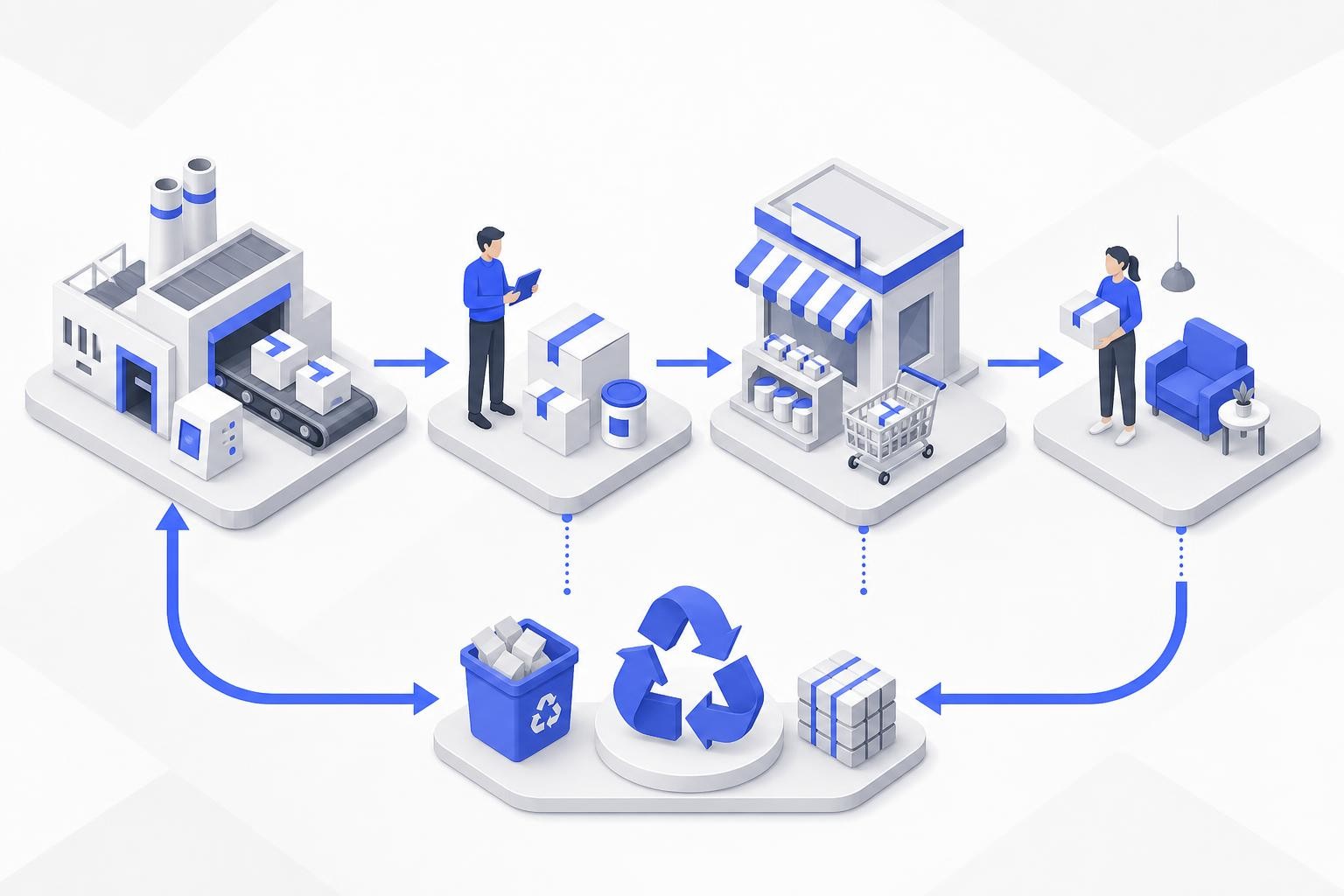
The PPWR's stated goals are to reduce packaging waste volumes, make all packaging recyclable in an economically viable way, increase the use of recycled materials, and harmonize rules across the single market. In practice, it touches every stage of the packaging lifecycle - from material selection and design through labelling, reuse systems, and end-of-life documentation.
 AI-generated image
Who Does the PPWR Apply To?
The scope is intentionally broad. The PPWR applies to all economic operators that place packaging or packaged products on the EU market, regardless of where the packaging is manufactured. This includes EU-based manufacturers, non-EU importers, distributors, retailers, and online marketplaces that facilitate sales into the EU.
The regulation defines roles under Article 3, and a single company can hold more than one role simultaneously across different SKUs:
- Manufacturer - any company that designs, manufactures, or has packaging manufactured under its own name or trademark. If your brand is on the packaging, you are almost certainly the manufacturer for PPWR purposes. Manufacturers must conduct conformity assessments, draw up the Declaration of Conformity, and maintain technical documentation.
- Importer - any EU-established company that places packaging or packaged products from a third country onto the EU market. Importers cannot assume foreign suppliers are compliant; they must verify conformity documentation before placing products on the market.
- Distributor - companies that make packaging available on the market but are not the manufacturer or importer. Distributors carry a lighter due-diligence duty: checking that the DoC accompanies the packaging and that labelling is compliant.
- Authorized representative - a company appointed by a non-EU manufacturer to handle obligations within the EU. For non-EU companies selling directly to EU customers, appointing an authorized representative is often a practical necessity.
- Online marketplaces - explicitly addressed as responsible actors when they handle packaging or logistics on behalf of third-party sellers.
One critical nuance: Article 21 of the PPWR reclassifies any importer or distributor selling packaging under its own brand as a manufacturer, requiring it to conduct conformity assessments, draw up the Declaration of Conformity, and retain technical documentation. Misclassifying your role leads to invalid DoCs and potential loss of EU market access.
No size exemption for core obligations. The PPWR does provide lighter administrative rules for micro-enterprises (broadly, those placing less than 10 tonnes of packaging on the EU market per year), but the core packaging design, substance, and labelling rules apply regardless of company size.
The Six Core Obligation Blocks
Art. 5 - Substance Restrictions (incl. PFAS)
Article 5 governs restrictions on substances of concern in packaging. Two sets of limits apply from 12 August 2026:
- Heavy metals - the combined concentration of lead, cadmium, mercury, and hexavalent chromium in packaging must not exceed 100 mg/kg. This limit carried over from the old PPWD, but it is now embedded in a regulation with direct enforcement.
- PFAS in food-contact packaging - this is the new and significant addition. From 12 August 2026, the PPWR prohibits placing food-contact packaging on the EU market if it contains per- and polyfluoroalkyl substances (PFAS) at or above specified concentration limits: 25 parts per billion (ppb) for any individual non-polymeric PFAS, 250 ppb for the sum of non-polymeric PFAS, and 50 parts per million (ppm) for total organic fluorine. These limits apply whether or not PFAS are intentionally added - meaning grease-resistant paper, certain coatings, and fluorinated barrier films all need to be assessed.
By 31 December 2026, the European Commission, assisted by ECHA, must prepare a report on substances of concern in packaging to determine whether further restrictions are warranted. Additional restrictions may follow.
Art. 6 - Recyclability and Design for Recycling (DfR)
Article 6 establishes that all packaging placed on the EU market must be recyclable. The guidance document published by the European Commission in March 2026 clarified that this general recyclability obligation applies from 12 August 2026 - but the detailed, harmonized Design for Recycling criteria and recyclability performance grades are still being developed.
By 1 January 2028, the Commission must adopt delegated acts setting Design for Recycling criteria and recyclability performance grades (A through E) for each packaging category. Manufacturers will then have 24 months to comply. From 1 January 2030, only packaging with recyclability grades A-C may be marketed. By 2038, only grades A and B will be permitted - effectively phasing out all lower-performing packaging formats.
Until the delegated acts are in force, companies should assess recyclability against existing harmonized standards and document their methodology in the technical file.
Art. 7 - Minimum Recycled Content in Plastic Packaging
Article 7 of the PPWR sets mandatory minimum post-consumer recycled (PCR) content quotas for plastic packaging placed on the EU market, with the first thresholds applying from 1 January 2030. The targets are differentiated by packaging category and application (contact-sensitive vs. non-contact), with higher targets applying from 2040.
Only post-consumer recycled plastics - materials collected after previous use by households, businesses, or institutions - count toward the targets. Compliance must be demonstrated through technical documentation tracing the origin and mass balance of recycled content throughout the supply chain. This is not a 2029 problem: securing PCR supply agreements and building the proof chain takes years.
Art. 10 - Packaging Minimization and Empty-Space Limits
Article 10 requires that packaging be reduced to the minimum necessary to ensure its functionality. Two distinct timelines apply:
- Sales packaging (primary): From 12 February 2028, companies filling sales packaging must ensure empty space is reduced to the minimum necessary for product protection and functionality. Until then, the existing EN 13428:2004 standard applies.
- Grouped, transport, and e-commerce packaging: From 1 January 2030 (or 36 months after the relevant implementing acts, whichever is later), a maximum empty-space ratio of 50% applies. The Commission will establish the methodology for calculating this ratio by 12 February 2028.
The regulation also restricts packaging features designed to create a misleading impression of product volume - false bottoms, double walls, and unnecessary layers are explicitly in scope.
Art. 11-12 - Reuse and Refill Targets
The PPWR's original reuse targets were significantly scaled back during the legislative process following industry pushback. In its final form, the regulation places greater emphasis on recyclability and chemical safety, though reuse obligations remain for specific sectors.
Reuse targets under Article 29 apply to transport packaging, e-commerce packaging, and beverage packaging. The specific targets and timelines for each sector are set out in Annex VI and linked to the adoption of secondary legislation. Reusable packaging must clearly indicate its reusability and how to return it.
For the food service and takeaway sector, Articles 32 and 33 introduce refill obligations. The Commission's March 2026 guidance document addressed several open questions on how reuse targets apply to international trade and which exemptions are available.
Labelling and Marking Harmonization (Art. 12-13)
The PPWR replaces the patchwork of national labelling schemes - France's Triman, Italy's environmental labelling decree, and others - with a single EU-wide system. From 12 August 2028 (or 24 months after the entry into force of the relevant implementing act, whichever is later), all packaging placed on the EU market must carry harmonized labels showing material composition and waste-sorting instructions using standardized pictograms.
The existing Commission Decision 97/129/EC identification system (the numbered material codes) continues to apply until 12 August 2028, after which it is superseded. Labelling of recycled and bio-based content is voluntary, but if companies choose to communicate this, they must use the harmonized labels from 2028 onward.
Many packages will also include QR codes or digital markers providing material composition, recyclability, and return or collection instructions - a step toward the Digital Product Passport ecosystem.
Declaration of Conformity and Technical Documentation
The PPWR does not use CE marking for packaging. Instead, compliance is demonstrated exclusively through two documents:
EU Declaration of Conformity (DoC) - a legally binding written self-declaration, defined in Article 39 with the model structure in Annex VIII. From 12 August 2026, every packaging type placed on the EU market must have a manufacturer-issued Declaration of Conformity; without a valid DoC, packaging cannot legally enter the EU market. The DoC confirms that the requirements of Articles 5 through 12 have been demonstrated.
Technical documentation (Annex VII) - the evidence file that backs up every claim in the DoC. It must include material composition data, substance test results, recyclability assessments, and (from 2030) verified recycled content percentages traced through the supply chain.
The DoC obligation takes effect from 12 August 2026, but not all Articles 5-12 requirements are active at that date. A DoC issued in 2026 covers only the articles legally applicable at that time - primarily substance restrictions under Article 5. The document will need to be expanded and updated as further deadlines arrive in 2028, 2030, and 2038.
Retention periods are fixed: five years for single-use packaging, ten years for reusable packaging, measured from the last placement on the market. Authorities can request access to the technical file within 10 days.
The manufacturer is the sole economic operator bearing legal responsibility for the packaging's compliance with sustainability and labelling requirements, regardless of who drafted the DoC. Importers must collect and verify the DoC from their suppliers; distributors must check that it accompanies the packaging.
PPWR Compliance Timeline: Key Deadlines at a Glance
| Date | Obligation | Article / Basis |
|---|---|---|
| 11 Feb 2025 | PPWR enters into force | Reg. (EU) 2025/40 |
| 12 Aug 2026 | General application date: substance restrictions (PFAS, heavy metals), DoC & technical documentation required, reuse system requirements take effect | Art. 5, 39, Annex VII–VIII |
| 12 Feb 2027 | EPR digital compliance identifier required | Art. 44 |
| 31 Dec 2026 | Commission/ECHA report on substances of concern due | Art. 5 |
| 1 Jan 2028 | Commission must adopt delegated acts on Design for Recycling criteria and recyclability grades | Art. 6 |
| 12 Feb 2028 | Commission must adopt implementing acts on empty-space ratio methodology; sales packaging minimization applies | Art. 10 |
| 12 Aug 2028 | Harmonized waste-sorting labels mandatory; Commission Decision 97/129/EC superseded | Art. 12, 70 |
| 12 Feb 2029 | Reusable packaging labeling required | Art. 12 |
| 1 Jan 2030 | Minimum recyclability grade C required; recycled content targets for plastic packaging apply; Annex V single-use format bans; 50% empty-space limit for grouped/transport/e-commerce packaging; packaging minimization requirements | Art. 6, 7, 10, 25, Annex V |
| 1 Jan 2035 | Packaging must be recyclable 'at scale' through established infrastructure | Art. 6 |
| 1 Jan 2038 | All packaging must achieve recyclability grade A or B | Art. 6 |
| 1 Jan 2040 | Higher minimum recycled content thresholds apply across all plastic packaging categories | Art. 7 |
Note: Several dates are contingent on the adoption of delegated or implementing acts. Where the regulation specifies "whichever is later," the actual deadline may shift. Monitor the European Commission's PPWR implementation page for updates.
What the PPWR Means in Practice for FMCG and Manufacturing Teams
The PPWR is not a single switch. It is a rolling series of obligations that require different functions to act at different times:
- Procurement and quality teams need supplier data on material composition, substance test results, and DoC documentation - starting now, for every packaging type in the portfolio.
- Sustainability teams need to map recyclability grades and recycled content baselines across the portfolio, and model the gap to 2030 targets.
- Compliance and legal teams need to confirm the company's economic operator role for each SKU, ensure DoCs are issued or collected, and establish a retention and audit-readiness process.
- Packaging design teams need to factor Design for Recycling criteria into every new development, even before the delegated acts are finalized, to avoid costly redesigns in 2028-2030.
The practical challenge is data. Most companies today store packaging specifications in spreadsheets, PDFs, and ERP exports - scattered across suppliers, markets, and internal teams. The PPWR requires a structured, auditable data foundation: material composition at component level, substance declarations, recyclability assessments, and recycled content proof chains, all linked to a DoC that authorities can request within 10 days.
Deeper Dives: Topic-Specific Guides
This page is the hub. For detailed guidance on each obligation block, explore:
- Recyclability & Design for Recycling (Art. 6) - how grades A-E work, what DfR criteria will require, and how to assess your portfolio today
- Recycled Content in Plastic Packaging (Art. 7) - PCR targets by category, supply chain documentation, and food-contact compliance under Regulation (EU) 2022/1616
- Labelling & Marking (Art. 12) - the harmonized pictogram system, what happens to national schemes, and artwork implications
- Declaration of Conformity & Technical Documentation (Art. 39, Annex VII-VIII) - what goes in the DoC, how to structure the technical file, and how to collect DoCs from suppliers
- Substance Restrictions & PFAS (Art. 5) - testing requirements, concentration limits, and what to do if your food-contact packaging uses fluorinated coatings
How Packa Helps
Managing PPWR compliance across hundreds or thousands of packaging SKUs is a data problem before it is a compliance problem. Packa's platform - built from 850+ real packaging projects with 300+ enterprise customers - digitizes scattered spec data from PDFs, Excel, and ERP exports into a structured, auditable source of truth.
From that foundation, Packa generates Declarations of Conformity, tracks recyclability and recycled content baselines, manages supplier documentation, and keeps your portfolio audit-ready as the regulation's requirements phase in through 2030 and beyond. No more chasing suppliers for PDFs two days before a market surveillance request.
Discuss your specific PPWR situation with a Packa expert — free of charge and without commitment. We'll help you identify your obligations, your data gaps, and the fastest path to audit readiness.
Talk to a Packaging ExpertFrequently Asked Questions
What is the PPWR (PPWR Verordnung)?
The PPWR — Regulation (EU) 2025/40 — is the EU's new Packaging and Packaging Waste Regulation. It entered into force on 11 February 2025 and applies generally from 12 August 2026. It replaces the old Packaging Directive 94/62/EC and sets binding rules on substance restrictions, recyclability, recycled content, packaging minimization, reuse, labelling, and the Declaration of Conformity. Unlike a directive, it applies directly in all 27 EU member states without national transposition.
Does the PPWR apply to my company if we are based outside the EU?
Yes. The PPWR applies to all economic operators placing packaging on the EU market, regardless of where they are established. Non-EU companies selling packaged goods directly to EU customers — including through e-commerce — are treated as the producer for compliance purposes unless an authorized representative or EU-based importer assumes those obligations.
What is the Declaration of Conformity (DoC) under the PPWR?
The DoC is a legally binding written self-declaration, defined in Article 39 of the PPWR, in which the manufacturer confirms that a specific packaging type meets the applicable sustainability requirements of Articles 5 to 12. It must be backed by a technical documentation file (Annex VII). From 12 August 2026, every packaging type on the EU market must have a valid DoC. Retention periods are five years for single-use packaging and ten years for reusable packaging.
When do recycled content targets apply?
The minimum recycled content targets for plastic packaging under Article 7 apply from 1 January 2030 (or three years from the entry into force of the relevant implementing act, whichever is later). Only post-consumer recycled plastics count toward the targets. Higher thresholds apply from 2040. Companies should begin building their PCR supply chain and documentation infrastructure well before 2030.
What happens to national packaging labelling schemes like France's Triman?
The PPWR replaces national labelling schemes with a single EU-wide harmonized system. From 12 August 2028 (or 24 months after the relevant implementing act enters into force), all packaging must carry harmonized labels with standardized pictograms for material composition and waste sorting. Member states will not be permitted to keep national labels alongside the EU harmonized labels after that date.
Is there a size exemption from PPWR obligations?
There is no general size-based exemption from the core packaging design, substance, and labelling rules. The PPWR provides lighter administrative rules for micro-enterprises (broadly, those placing less than 10 tonnes of packaging on the EU market per year), but the substantive obligations — substance restrictions, recyclability, DoC — apply regardless of company size.