

Many packaging managers are familiar with the term EPR - but few have truly gotten to grips with it. A registration here, a quantity report there, a dual system in between: at first glance, the regulatory framework looks like little more than bureaucratic overhead. In reality, Extended Producer Responsibility has long been a tangible cost driver - and with the PPWR taking effect in August 2026, it becomes a strategic lever that directly impacts your packaging costs, your market access, and your supply chain.
This guide explains what EPR means, who it affects, what three core obligations apply, and what changes under the new EU Packaging Regulation.
What Is EPR? Definition and History of Extended Producer Responsibility
EPR stands for Extended Producer Responsibility. EPR is an environmental policy instrument that transfers responsibility for a product's end-of-life management to the producer. Manufacturers pay EPR fees based on the quantities of packaging or products they place on the market.
The core idea: whoever puts packaging into circulation also bears the costs of its collection, sorting, and recycling - not the taxpayer.
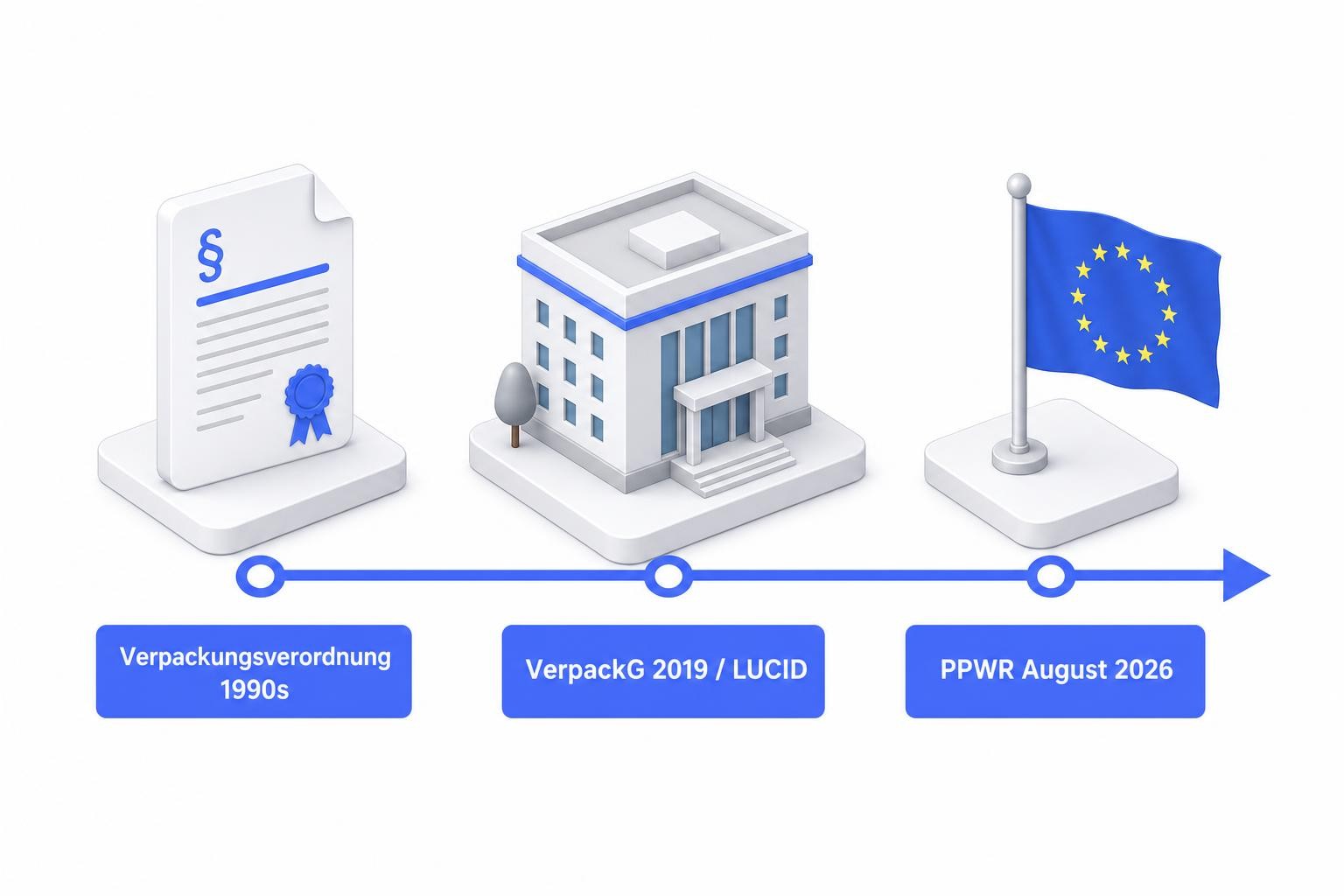
From the Packaging Ordinance to the VerpackG 2019
Germany has one of the longest EPR traditions in Europe. The principle was introduced as far back as the 1990s under the Packaging Ordinance. The Packaging Act (Verpackungsgesetz, or VerpackG), which replaced the Packaging Ordinance on January 1, 2019, simultaneously established the Central Agency Packaging Register (Zentrale Stelle Verpackungsregister, ZSVR). The ZSVR was given responsibility for organizing, implementing, and overseeing the Packaging Act - with the LUCID Packaging Register as its central tool.
The PPWR as the Next Step: August 2026
The Packaging and Packaging Waste Regulation (EU Regulation 2025/40) entered into force on February 11, 2025, and applies from August 12, 2026. It replaces the previous Packaging Directive 94/62/EC and harmonizes packaging rules directly across all 27 member states - without the detour of national implementing legislation.
The PPWR (EU 2025/40) becomes binding across all EU member states on August 12, 2026.
For Germany, this means: the existing Packaging Act (VerpackG) will be replaced by a new Packaging Law Implementation Act (Verpackungsrecht-Durchführungsgesetz, or VerpackDG). The Federal Cabinet adopted the draft bill on February 11, 2026; the Bundestag and Bundesrat still need to pass the legislation for it to take effect on August 12, 2026. The VerpackDG governs what the PPWR deliberately leaves to member states: who enforces, who sanctions, and how Germany's established structures will be carried forward.
 AI-generated image
Who Is Subject to EPR Obligations in Germany?
The most common question is: Does this even apply to me? The answer is almost always: yes.
The registration requirement applies to every manufacturer, importer, and retailer, regardless of company size or the volume of packaging placed on the market. Registration and reporting obligations apply from the very first filled packaging unit placed on the market. There are no de minimis thresholds.
Specifically, the following parties are affected:
| Party | Example | EPR Obligation |
|---|---|---|
| Brand manufacturer | FMCG company that produces and sells products in Germany | Full obligations |
| Importer | Company importing goods from China into Germany | Full obligations as first placer on the market |
| Online retailer | D2C brand selling via its own store or Amazon | Full obligations |
| Foreign manufacturer | US brand with no German establishment shipping to Germany | Authorized representative required |
The Packaging Act uses the umbrella term "manufacturer" (Hersteller). This refers to any party that is the first to fill packaging with goods - or the first to bring filled packaging onto the German market (importer) - where that packaging typically ends up as waste with private end consumers.
Important for online retailers and marketplaces: Online marketplaces such as Amazon or eBay refer to this shorthand as the "EPR number." Companies must register this EPR registration number with online marketplaces - failure to do so risks suspension of their seller account.
No minimum threshold: The VerpackG applies from the very first filled packaging placed on the market — regardless of company size or annual revenue. Startups, D2C brands, and small online retailers are fully subject to EPR obligations.
The Three Core EPR Obligations in Germany
Germany's EPR system for packaging rests on three pillars that build on one another.
1. Registration in the LUCID Packaging Register (ZSVR)
The first step toward fulfilling your obligations is registering in the LUCID Packaging Register, operated by the ZSVR. This process must be completed once by every company before placing the first packaging unit on the market. LUCID registration is free of charge and available exclusively online.
Without a valid LUCID registration number, goods may not be offered for sale in Germany. This number - often referred to as the EPR number - must then be communicated to the dual system.
LUCID registration is free and must be completed before placing any packaging on the market for the first time.
Missing or incorrect registration in the LUCID Packaging Register can result in sales bans and fines of up to €100,000.
2. Participation in a Dual System
After registration comes licensing your packaging. Cost participation in packaging recycling takes place through the so-called licensing (or system participation) of packaging with a dual system. This is mandatory for both manufacturers and retailers that place sales packaging on the market - whenever a retailer or manufacturer acts as the first placer on the market and puts packaging materials into circulation in Germany that ultimately end up with end consumers.
License fees are determined by two main factors: the weight and the material type of the packaging. Each material - from cardboard to plastic to glass - carries a different per-kilogram rate, set annually by the dual systems based on recycling costs. A company placing 1,000 kg of plastic packaging on the market pays a significantly higher fee than one placing 1,000 kg of paper packaging.
EPR fees in Germany vary by material and are calculated per kilogram of packaging placed on the market.
The formula is straightforward: Weight (kg) × fee rate (€/kg) = total fee. What gets complex: with a broad packaging portfolio spanning dozens of material variants, composite materials, and transparent windows, the differences quickly add up to substantial annual amounts.
3. Quantity Reporting and Data Reporting Obligations
The Packaging Act reporting obligation requires every first placer on the market to register in the LUCID Packaging Register and regularly report the quantities and material types of their packaging to both the dual system and the ZSVR.
Reports must be submitted to two places simultaneously: the dual system and LUCID. The reported quantities must match exactly at both locations. The ZSVR systematically cross-checks the data to identify discrepancies and free-riders.
Key deadlines at a glance:
| Frist | Pflicht | Hinweis |
|---|---|---|
| Vor erstem Inverkehrbringen | LUCID-Registrierung | Einmalig, kostenlos, online |
| Laufend (quartalsweise/jährlich) | Mengenmeldung an duales System + LUCID | Mengen müssen identisch sein |
| Bis 15. Mai des Folgejahres | Jahresabschlussmeldung (Ist-Mengen) | Bindende Frist, Bußgeld bis 10.000 € |
| Ab bestimmten Mengenschwellen | Vollständigkeitserklärung (VE) | Z. B. ab 30 t Kunststoff oder 50 t Papier/Jahr |
The annual final report is a mandatory data submission for all manufacturers and retailers placing system-participation-obligated packaging on the market in Germany. It serves to transmit the exact quantities of packaging materials for the entire prior year to the ZSVR via LUCID. This actual-quantity report must be submitted by May 15 of the following year. The data must match the reports submitted to the dual system exactly, as discrepancies can result in sanctions.
The annual final report for actual quantities must be submitted to the LUCID register each year by May 15.
What Changes Under the PPWR from August 2026
The PPWR is not simply an update to the VerpackG - it fundamentally changes the rules of the game. Three developments are particularly relevant for EPR compliance.
EU-Wide Harmonization of EPR Systems
Until now, every EU country had its own EPR system. Under the old EU directive framework, each member state wrote its own implementation: Germany built LUCID, France built CITEO, Italy built CONAI. With the PPWR, producer registration, reporting, and oversight of Producer Responsibility Organizations (PROs) are being strengthened and standardized across the EU.
For companies operating in multiple EU countries, this means greater comparability - but also more obligations. From August 2026, the PPWR makes it mandatory to appoint an authorized representative in every EU country where a company has no local establishment.
Eco-Modulation: Fees Based on Recyclability
This is the most significant development for packaging managers and procurement teams: eco-modulation of fees becomes mandatory EU-wide for all member states. Packaging that is difficult to recycle will be subject to higher fees; compliant designs will receive reduced fees.
Extended Producer Responsibility (EPR) is being harmonized EU-wide through the PPWR. Going forward, EPR fees will be tiered according to the environmental performance of the packaging (modulated fees): packaging with higher recyclability and a higher recycled content share will pay lower fees, while hard-to-recycle packaging will pay more.
Under the PPWR, eco-modulation of EPR fees becomes mandatory EU-wide: recyclable packaging pays less, hard-to-recycle packaging pays more.
Eco-modulation pulls the compliance question into product design - not just end-of-year paperwork. For product teams, this creates a meaningful feedback loop: decisions made by designers, procurement teams, and packaging engineers directly affect what the finance team pays in EPR fees six months later.
In Germany, eco-modulation is already embedded in the VerpackG - but it has not yet been fully implemented. A significant change is therefore on the horizon.
New Reporting Requirements and Declaration of Conformity
One of the most important administrative changes is the obligation to produce a Declaration of Conformity for each individual packaging unit, effective August 12, 2026. This confirms that packaging complies with Articles 5 through 12 of the PPWR - covering substance restrictions, minimization requirements, and recyclability in particular.
The greatest effort lies not in any single detailed requirement, but in building reliable packaging data, clear accountability, and audit-ready processes.
How Packa Simplifies EPR Compliance
EPR compliance sounds like an administrative issue. In practice, it's a data problem.
Many high EPR costs go unnoticed because data is missing or reports contain errors: incomplete or incorrect entries (e.g., missing weights, wrong codes, missing component assignments), manual Excel spreadsheets with multiple versions and owners. Packa regularly sees in client projects that 30-70% of the packaging data relevant to compliance and EPR calculation is missing or inconsistent. Material data sits in the ERP, weights are buried in technical drawings, recyclability information is scattered across various Excel files. Supplier data is requested by email and transferred manually.
This is exactly where Packa comes in:
The result: packaging managers, sustainability teams, and procurement work from a single shared data foundation - instead of piecing together EPR compliance from siloed sources every year.
Have your packaging portfolio analyzed for EPR savings potential — free of charge and without obligation.
Analyze My EPR CostsConclusion: EPR as a Strategic Lever, Not a Compliance Chore
EPR has been mandatory in Germany since 2019 - and with the PPWR from August 2026, it becomes more complex, but also more manageable. Companies that treat EPR purely as a compliance matter pay more: in fines, in incorrectly licensed quantities, in non-optimized materials.
Companies that solve EPR as a data problem come out ahead: lower fees through better material choices, clean reports without rework, and a data foundation that is already ready for PPWR requirements from 2026 onward.
The three most important action steps right now:
- Check your LUCID status - Are all brands and packaging types correctly registered?
- Validate your quantity reports - Do the figures in LUCID and with the dual system match?
- Start material optimization - Which packaging units are paying excessive EPR fees today because they are poorly recyclable?
Our experts will assess your EPR situation and show you how Packa can automate your compliance processes.
Talk to a Packaging ExpertWhat does EPR stand for?
EPR stands for Extended Producer Responsibility. The principle requires companies that place packaging on the market to bear the costs of collecting, sorting, and recycling that packaging.
Who is required to register in the LUCID packaging register?
Any company that commercially places filled packaging on the German market for the first time — regardless of company size, location, or volume. This applies to manufacturers, importers, online retailers, and foreign companies shipping to Germany.
What is an EPR number?
The EPR number is the LUCID registration number issued upon successful registration with the ZSVR. Online marketplaces such as Amazon and eBay require this number before products can be listed.
What changes with the PPWR starting in August 2026?
The PPWR harmonizes EPR systems across the EU, makes eco-modulation of fees mandatory (more recyclable packaging pays less), introduces a declaration of conformity per packaging type, and requires companies without a presence in the target market to appoint a local authorized representative.
What is eco-modulation in EPR fees?
Eco-modulation means that EPR fees are tiered based on a packaging's recyclability and recycled content. Highly recyclable packaging pays lower fees; packaging that is difficult to recycle pays more. This becomes mandatory across the EU from August 2026.
What is the deadline for the annual final report?
The annual final report (actual quantities for the previous year) must be submitted to the LUCID register each year by May 15. Late or incorrect submissions can be treated as a regulatory offense, subject to fines of up to €10,000.